

74AVNEti
4-
Accord With Syria?
Mr. Assad offers
ion-belligerency;
Mr. Rabin, a
partial Golan
pullout. That
could be enough
for now, indicates
tamar Rabinovich.
OUGLAS DAVIS
)REIGN CORRESPONDENT
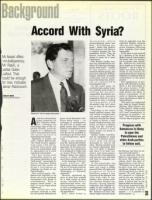
Rabinovich:"Syria is opaque about peace."
A
mid the international
crises clamoring for
Bill Clinton's atten-
tion, including the
continuing saga of the ex-
pelled Islamic activists
trapped in a Lebanese no-
man's land, good news about
the peace process is
emanating from Israel.
Speaking in London last
week, Itamar Rabinovich,
who heads Israel's negotia-
ting team with Syria,
revealed that Israel and
Syria are tantalizingly close
to agreement on a joint
statement of principles.
Two key issues still
outstanding, however, are
the precise definition of the
"bold peace" enunciated by
Syrian President Hafez
Assad and the extent of
Israel's willingness to
withdraw its forces on the
Golan Heights.
Not surprisingly, Mr.
Rabinovich declined to be
drawn out on the territorial
concessions that Israel is
contemplating: "Syria is
opaque about peace," he
said, "so we are vague about
withdrawal."
Mr. Assad has been
curiously reluctant to offer
his own precise definition of
peace. Israel demands a full-
blown peace treaty — an
exchange of ambassadors,
the free flow of people and
goods across their common
frontier, normalization of re-
lations — but it suspects
that the Syrian president is
unwilling to go further than
a non-belligerency agree-
ment.
Israel is also anxious to
hear Mr. Assad talk publicly
to his own people, including
opponents of the peace pro-
cess, about the compromises
he is prepared to make, just
as Israeli Prime Minister
Yitzhak Rabin has spoken
frankly to Golan settlers
about their uncertain future.
In the language of his new
trade, however, Mr.
Rabinovich, former rector of
Tel Aviv University and now
ambassador-designate to
Washington, is "cautiously
optimistic."
However, agreement ap-
pears to have been reached
on a wide range of other
issues, including Syria's
demilitarized zones, con-
fidence-building measures,
as well as arrangements for
monitoring and inspecting
the agreements.
Still, sober heads in
Jerusalem, while
acknowledging there has
been "far-reaching pro-
gress," doubt that Israel's
vision of peace with Syria is
a realistic prospect for the
immediate future. They do
believe, however, that Mr.
Assad is ready for a more
limited pact.
The Syrian leader has,
they say, abandoned his am-
bition of achieving strategic
parity with Israel — thanks
to the demise of his
erstwhile Soviet sponsor, the
pervasive influence of Wash-
ington, domestic economic
constraints and an accep-
tance that Israel has achiev-
ed an unbeatable
technological lead.
At the same time, he
evidently feels unable to pay
the political price Israel is
seeking for its still-
unspecified territorial con-
cessions and, supreme
pragmatist that he is, he is
expected to seek a working
arrangement with
Jerusalem that will allow
him to keep all his options
open.
According to one senior
Israeli political source, this
will involve a limited polit-
ical accord, imperfect as it
might be, because Mr. Rabin
is unable to deliver a total
Israeli withdrawal from the
Golan (as Syria is deman-
ding) and Mr. Assad is
unable to deliver a total
peace treaty (as Israel is
demanding).
Neither leader, therefore,
will be compelled to make
the sort of political conces-
sions that are being
demanded by, and of, the
other. Having reached such
an interim agreement, both
men will agree to disagree
and leave it to their suc-
cessors, even future genera-
tions, to fill in the fine print
and take the next step that
will lead to complete nor-
malization.
In the meantime, the
interim framework agree-
ment will create a modus
operandi that will reduce the
prospects of future
hostilities, ensure a con-
tinuation of the dialogue and
allow both sides to con-
solidate their private polit-
ical interests without con-
stantly raising mutual
suspicions. One tangible ex-
ample of this could be de-
tected in the suggestion by
Mr. Rabinovich that Mr.
Assad might extricate Israel
from its imbroglio over the
expelled Hamas radicals
who are still trapped in
south Lebanon following
their expulsion from Israel
last month.
If the issue is not resolved
by a decision of the Israeli
High Court of Justice before
the peace talks are schedul-
ed to resume next month,
Mr. Rabinovich believes
Syria might act to break the
impasse — not as a favor to
Israel, but rather to demon-
strate to the Clinton ad-
ministration Syria's positive
influence in Lebanon and its
commitment to the peace
process.
The significance of pro-
gress with Damascus is that
Syria is the pace-setter in
the peace process. If Mr.
Assad goes ahead, the other
Arab parties are likely to
follow; conversely, if he
stalls or obstructs negotia-
tions, the others are likely to
also hold back.
This point was underlined
last week by Israeli Health
Minister Haim Ramon, the
Labor Party's rising young
star. "Progress on one track
will lead immediately to
progress on another," he
said. "The Palestinians are
worried about progress with
Progress with
Damascus is likely
to spur the
Palestinians and
other Arab parties
to follow suit.
the Syrians and they do not
want to be left behind."
In an interview with the
Hebrew-language daily
Ha'aretz, Mr. Ramon was
upbeat about the state of
negotiations with Syria.
"Proposals have been put
forward from both sides,
significant changes have oc-
curred and there is a devel-
opment. We told them we
are prepared to withdraw
and we are now waiting for
answers on the nature of
peace. I believe that on the
basis of what we have said —
that we are prepared to app-
ly UN Security Council
resolution 242 in all its
aspects — it is possible to
achieve peace." ❑
Cf)
0)
0)
CN.1
>-
CC
33