

:1
'1'
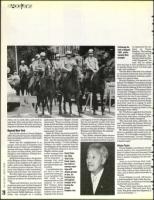
Following the
riots of August,
1991, police
showed their
strength.
other, not on each other, and work to
heal those rifts, and not allow those in-
cidents to fracture the basic structural
long-term interests of our relationship."
J E WIS H N EWS
Beyond New York
How do the events in Crown Heights
affect the already tenuous relationship
between blacks and Jews in other parts
of the country?
Some say the neighborhood is so
unique, with its mix of Chasidim and
blacks, many of whom are of Caribbean
descent and many deeply enmeshed in
the culture of urban poverty, that Crown
Heights is not indicative of black-Jew-
ish relations elsewhere.
Rabbi David Saperstein, the director
of the Religious Action Center of Reform
Judaism and a longtime civil rights cru-
sader, said Crown Heights does not fit
the national pattern because "the cul-
tural and religious walls separating"
blacks and Jews there "are enormous."
But other observers suggest that what
happened in Brooklyn is just the most
dramatic symptom of a spreading social
virus.
"Black anti-Semitism was the most
important root cause of what happened
here," said Rabbi Joseph Spielman, chair
of the Crown Heights Jewish Commu-
nity Council. Rabbi Spielman, a Lubav-
itcher, has emerged as a leading
spokesman for Crown Height's Jewish
community. 'There is a strong, virulent
strain of anti-Semitism running through
the black community, and not limited
to those on the lowest end of the eco-
nomic scale," he said.
Rabbi Avi Weiss, the controversial Or-
thodox activist from Riverdale, said he
believes "the nerves are particularly raw
here - but it's just beneath the surface
around the country." A critic of Mayor
Dinkins, the rabbi is worried that the
unwillingness of city officials to confront
the anti-Semitic element in the Crown
Heights violence sends
a clear message that David Dink-
black anti-Semitism ins, New
will be tolerated - a York's first
message that could
black mayor,
resonate in other im-
poverished black com- has held nu-
merous meet-
munities.
A complicating fac- ings with
tor here is that the Jewish groups
Lubavitch communi- of late, de-
ty, an insulated Cha-
sidic world, is not fending him-
representative of the self against
majority of Jewish charges of al-
New Yorkers. Some lowing the
observers feel that es- Crown
tablishment Jewish
Heights riots.
leaders were slow to
respond to the trauma
and tragedy of Crown Heights because
they do not identify readily with their
Chasidic brethren. Others charge that
the Jewish establishment is more re-
sponsive to the pain of others - Haitians,
Bosnians and Somalians, for example -
than to some fellow Jews.
Gary Rubin, national affairs director
for the American Jewish Committee,
conceded that organized Jewry was slow
to respond to the vio-
lence in Crown
Heights. "Not calling
it a pogrom is a way of
psychologically dis-
tancing ourselves from
what happened," he
said. But he added
that the way to solve problems is not
to ascribe blame but to "sit down and
work with coalitions."
The fact that Lubavitch is by nature
an insulated community does not make
for strong intergroup relations, partic-'
ularly at a time of crisis.
Murray Friedman, who served on the
federal Civil Rights Commission during
the Reagan era, has concluded that the
black-Jewish alliance of the civil rights
days is simply gone. 'We're going to have
to stop this wringing of hands and rec-
ognize that the alliance cannot be re-
asserted in the way it once existed."
The real issue today, he said, is how
to "normalize" relations between blacks
and Jews. And he is urging "a more
hardheaded, pragmatic view of these is-
sues because we cannot go back to the
strategies of the 1960s."
Mr. Friedman suggested that blacks
and Jews may need a degree of sepa-
ration from each other, a cooling off pe-
riod, but Gary Rubin disagreed.
"We need each other, politically," he
said. "Increasing the distance between
our communities only breeds more in-
tolerance and anti-Semitism."
Mr. Rubin said that racisim among
Jews is a problem that needs to be ad-
dressed. "It is the hidden scandal in the
Jewish community," he said, "though
we want to fool ourselves into thinking
it doesn't exist."
Urban Fears
Crown Heights, according to worried
Jewish leaders, has encapsulated the
fears of urban Jews and increased the
feeling of vulnerability that has always
been a shadow hanging over the com-
munity.
Jews are torn between their tradi-
tion of liberalism, according to sociolo-
gist Seymour Martin Upset, and their,
growing feeling of vulnerability as Amer- -`
ica's cities continue their sickening de-
cline, and as ethnic politics increases in
ferocity.
Crown Heights, he said, will become
a 'polarizing factor" both within the Jew-
ish community, and between the black =;
and Jewish communities.
"There will be more tension, more di- (
vision," he said. "This isn't good, obvi-
ously. But given what has happened, it
may be inevitable."
❑