
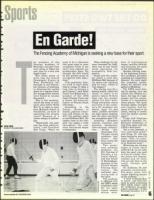

En Garde!
The Fencing Academy of Michigan is seeking a new base for their sport.
STEVE STEIN
SPECIAL TO THE JEWISH NEWS
01'
Fencers practice at a Southfield school.
he members of the
Fencing Academy of
Michigan thought they
were going to begin the
new year in a new and
bigger home.
But when plans to
move into the Jewish
Community Center in
West Bloomfield fell
through in mid-Decem-
ber because of problems
in obtaining the needed
space on a regular basis,
the disappointed fencers
were forced to resume
the search.
Why is the academy,
which has been in exis-
tence since before World
War II, so eager to move
from McIntyre School in
Southfield, its base of
operations for several
years? Because of a
recent change in philoso-
phy.
"Historically, the acad-
emy has been adult-ori-
ented," said President
Rob Tripp. "What we
want to do is introduce
this great sport to more
youngsters while at the
same time expand our
membership base. We
thought the JCC would
be the perfect place to
accomplish both objec-
tives."
"Like gymnasts, fenc-
ers need to start when
they're young. It takes a
long time to develop a
good fencer," said Head
Coach Yuri Rabinovich, a
member of the 1972
Israel Olympic Team and
a former All-American
fencer at Wayne State
University.
According to Ed
Taylor, director of
health, physical educa-
tion and fitness at the
JCC, the academy asked
to use Shiffman Hall, the
largest room at the com-
plex, two nights a week
throughout the year
when discussions began
in September.
When bookings for the
room increased for 1993,
there was no way Taylor
could guarantee its
availability that fre-
quently.
Tripp said the acade-
my needs a room like
Shiffman Hall because of
its space and lighting
and its floor, which is
"not slippery."
The playing area for a
fencing match, called the
"strip," or "piste," is 14
meters (about 46 feet)
long and two meters
(about 6.5 feet) wide.
Tripp estimates about
one-third of the acade-
my's 60 members are
adults (ages 18 and
older), another one-third
are high school students
and the other one-third
are youngsters ages 7-12.
Academy members
include regional and
national champions,
international competi-
tors, NCAA All-
Americans, U.S.
Olympic squad
members and
others who
fence solely for
recreation.
Two promi-
nent academy
members are
Bill Goering of
Romulus, a na-
tional official,
and Ann Ezzell
of Birmingham,
secretary of the
United States
Fencing Asso-
ciation, the
national gov-
erning body of
the sport.
The academy
is affiliated with
the USFA, which
establishes rules
for its sanc-
tioned events,
selects mem-
bers of international
teams, certifies officials
and promotes the sport
in the United States.
Besides offering class-
es for beginning fencers,
the academy provides
coaching for competitive
fencers. On each night
the academy meets,
about 35 fencers will
gather at McIntyre.
The USFA touts fenc-
ing by saying, "you can
acquire the reflexes of a
boxer, the legs of a high-
jumper and the concen-
tration of a tournament
chess player. The sport
develops agility, strength
and cunning. And be-
cause of the speed of its
action, fencing is consid-
ered the fastest martial
sport."
Tripp and longtime
academy member Dr.
Bernard Goldstein of
Oak Park agree with the
USFA's description.
"It's a very personal, a
very individual sport,"
said Tripp, 47, who has
been fencing for about 30
years. "Plus, it's some-
what glamorous because
of its historical roots."
Historians say fencing
began in China about
2,000 B.C.E. In its early
days the sport was used
to train for combat. Now,
the prizes are champi-
onships and, for those
who are the best in the
world, Olympic gold
medals.
Dr. Goldstein, 59, still
competes occasionally.
For many years, he's
taught beginning fencers
at the academy.
"I think everyone likes
to teach... and feels the
need to teach something
they really enjoy," said
Dr. Goldstein, an osteo-
pathic physician. "I like
fencing because it's a
EN GARDE page 46