

BacH grou
Mixed Signals
I
MA FRIEDMAN
SPECIAL TO THE JEWISH NEWS
Rabin keeps
maneuvering as
the doves keep
backpeddling and
an agreement with
Syria is hinted at.
t's almost as if Prime
Minister Yitzhak Rabin
had tempted fate — and
lost.
No sooner had he told the
22nd Congress of the World
Union of Jewish Students
that the previous two weeks
of quiet have proven that the
government was right in
deciding on the deportation
then the news broke that
Haim Nahmani of the Shin
Bet had been brutally knifed
and hammered to death, in
the heart of Jerusalem, by
two members of Hamas (one
of them an informer working
for the secretive, internal
security agency).
Mr. Nahmani's death was
the second murder of an
armed Israeli security figure
by Hamas terrorists in less
than a month. The kidnapp-
ing and murder of Border
Guard Nissim Toledano of
Lod in mid-December was
the act that precipitated the
deportation of 415 Hamas
activists.
While the Rabin govern-
ment scrambled to respond
to the resumption of Hamas
terrorism, in many ways it's
still responding to the
aftermath of the deportation
— which, like a rock hurled
into a pool, created ripples
that have been rocking the
Israeli political estab-
lishment for weeks now.
Last week alone opened a
number of seemingly
clashing prospects for the
Rabin government and the
peace process, all of which
left the Israeli public bobb-
ing about in a sea of ambigu-
ity — and no little confusion.
Take, for example, the poll
done by journalist Yossi
Melman among the govern-
ment's 17 ministers (before
Yossi Sarid joined it as min-
ister of environment, upping
the number to 18) showing
considerable backpeddling
among the "doves" who
were either known or
presumed to support the in-
itiation of direct talks with
the PLO.
Of the nine dovish min-
isters, four senior figures
declined to participate in the
survey. But the remaining
five sounded chastened by
the show of broad public
support for the deportations
and generally aggressive
line maintained by Mr.
Rabin ever since.
Climbing down from
earlier stands, for example,
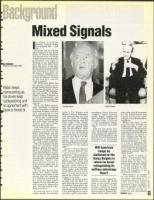
Yitzhak Rabin
Labor's Uzi Baram and
Meretz's Amnon Rubinstein
both declared that the time
was not right for holding
direct negotiations with the
PLO. Labor's Ora Namir
came right out and declared
that she was against talks
with the PLO-Tunis, while
Meretz's Ya'ir Tzaban spoke
wanly of the government
"reconsidering its attitude
toward the PLO" if the
latter were to "play a
positive role and encourage
the [local] Palestinian repre-
sentatives to the [peace]
talks."
Labor's Chaim Ramon
took shelter behind the
"government's policy
guidelines," which commit it
to the so-called Madrid for-
mula — though both Mr.
Ramon and Ms. Namir said
that, contrary to the Madrid
ground rules, Faisal al-
Husseini (at once the delega-
tion's leader and officially
banned from the it as a resi-
dent of east Jerusalem)
should be allowed to par-
ticipate in the talks.
Whether or not the notion
of talks with the PLO is a
dead letter for now, the most
remarkable thing about the
survey showing the quiet
capitulation of doves is that
it was published on the same
day that a poll in the mass-
Hafez Assad
circulation Yediot Aharonot
yielded a rather startling
result: Asked whether the
PLO should be included in
the peace talks, a minority
— but, nonetheless, whopp-
ing 47 percent answered
"Yes."
And yet, the prime min-
ister was working in strange
ways. Despite the expression
of overwhelming public sup-
port for his government and
indications of movement
toward a more pragmatic
Will American
troops be
stationed on the
Golan Heights in
return for Israel
relinquishing its
military advantage
there?
outlook on the tangled Pa-
lestinian reality, Mr. Rabin
stuck to his widely - touted
plan to broaden his 62-
member coalition by taking
in two right-wing elements:
Tzomet and the National Re-
ligious Party, both of which
take a dim view of autonomy
for the Palestinians and
regard territorial com-
promise on the West Bank as
anathema.
Which way, then, is the
wing blowing? Toward an
understanding with the
"mainstream" Palestinians
that would acknowledge the
stabilizing role of the PLO in
their affairs? Or toward a
more complex and less cor-
dial composition of the
Israeli government — if only
as a way of signaling the
recalcitrant Palestinians
that the present government
is the most accommodating
negotiating partner they're
likely to get?
The answer, it seems, is
neither. If the wind is blow-
ing in any direction, it's
toward Syria. In the course
of the past week there's been
a virtual cascade of talk
from the highest levels
about the prospects of an
agreement with Syria.
What seems to be cooking
on the Golan has been
variously described as a
Camp David-style accord
and a bona fide peace
agreement whose execution
will run parallel to the five-
year interim period of
autonomy and negotiations
SIGNALS page 34