
A
A JARC
resident
learns to
communicate
with the aid of
a simple
keyboard.
By Elizabeth Applebaum, Assistant Editor
Photos by Glenn Triest
LU
CC
UJ
LLJ
100
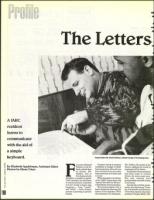
Howard Golden with Johnnie Holloway, assistant manager of the Grosberg Home.
F
or years, Howard
Golden lived be-
hind a closed door
of silence. Mr.
Golden, who is
developmentally
disabled, is unable to speak.
Until recently, his only form
of communication consisted
of a few words in basic sign
language — "pop," "cookie"
and "more" — and a clumsy
system of pointing at picture
boards.
Imagine trying to express
loneliness or hunger or child-
hood memories when all you
have in front of you are card-
board pictures of a lamb and
a house.
What changed everything,
what JARC supervisors say
"opened the door for Howie,"
is facilitated communication.
The process begins with a
basic keyboard showing the
letters of the alphabet. With
the assistance of a facilitator,
Mr. Golden, 28, points to the
letters, spelling out words or
sentences of his choice.
Facilitated communication
has been used, in various
forms, for some years now.
But only recently have
professionals started to take
it seriously.
Among the earliest propo-
nents were Rosemary Cross-
ley of Australia and Syracuse
University special education
professor Douglas Biklin. Ms.
Scanned image of the page. Keyboard directions: use + to zoom in, - to zoom out, arrow keys to pan inside the viewer.
January 15, 1993 - Image 104
- Resource type:
- Text
- Publication:
- The Detroit Jewish News, 1993-01-15
Disclaimer: Computer generated plain text may have errors. Read more about this.