

V011...1
Fueled By Despair slam Marches On
W
The Palestinian
deportees
are just one
example of the
fundamentalist
Muslim
ideology that
is sweeping
the Arab
world.
DOUGLAS DAVIS
FOREIGN CORRESPONDENT
hatever the fate of
the Hamas ac-
tivists on their
freezing hillside in
Lebanon, they will remain
an emblem of the final
decade of the 20th century
and their message will
dominate the international
agenda well into the next.
Of all the voices now
demanding attention in the
Middle East, none is more
persistent or more per-
suasive than the hypnotic
chant of the muezzin calling
worshipers to prayer.
At a moment of profound
despair throughout the
Muslim world — when pan-
Arabism is pronounced dead,
when political elites are
unable to meet the needs of
their exploding populations,
when fabulous wealth is in-
different to grinding poverty
— millions of Arabs are
seeking solace in militant
Islam.
From Algeria, Morocco
and Tunisia to the desolate
wastes of Sudan and
Somalia, from Egypt and
Jordan to Saudi Arabia,
Kuwait and Yemen, tens of
thousands of Islamic ac-
tivists are leading tens of
millions of followers to ques-
tion molds that have failed
to provide schools and
hospitals, jobs and houses.
They are questioning their
secular legal systems, their
secular political rulers, even
the legitimacy of their
secular states, which owe
their existence — and their
arbitrary boundaries — to
the whims of departing colo-
nial masters in the wake of
World War I.
Islamic fundamentalism is
on the march with an ir-
resistible message of spiri-
tual succor and temporal
support, replacing old mes-
sages of Arab glory with new
messages of Muslim em-
pires.
In Western minds, the Ira-
nian-backed Hezbollah
movement is associated with
car-bombs, hijackings and
kidnappings. But to the
Muslim Shi'ite underclass of
Lebanon, Hezbollah has
sounded a quite different
message as it assiduously
translated its religious rhet-
oric into practical aid.
Iranian largess has in-
cluded helping Hezbollah
develop its political muscle
based on a comprehensive
social-support network —
orphanages, schools, medical
services, welfare centers —
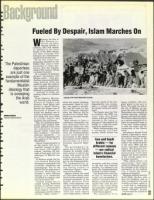
A group of the recent deportees at prayer.
which the central Lebanese
government, beset by 'civil
war, was unable to provide.
The pay-off came in last
year's Lebanese elections
when the Muslim Shi'ite
beneficiaries helped Hez-
bollah to a stunning triumph
at the polls.
More recently in Cairo, a
calamitous earthquake not
only destroyed scores of
apartment blocks but also
rocked the foundations of
Hosni Mubarak's regime
when the fundamentalists
easily outstripped the
government in the quality
and quantity of aid it offered
thousands of newly
homeless, destitute Egyp-
tians.
The government's re-
sponse was to order that all
mosques be brought under
state control, to send in the
troops and round up 750
Islamic activists, and to
outlaw the provision of wel-
fare by the fundamentalists.
The fundamentalists re-
sponded, in turn, by attack-
ing foreign visitors to
undermine Egypt's impor-
tant tourist industry.
Algeria showed the hand
of a less astute player when
Saudi Arabia emerged as the
principal benefactor of the
Islamic Salvation Front
(FIS), which decisively won
the first round of last year's
election. After the National
Liberation Front (FLN),
which has ruled Algeria
since independence, realized
that the march of the fun-
damentalists was unstop-
pable, it simply cancelled
the second round and seized
power.
The Saudis were the first
to recognize the FLN, an-
other sign that Saudi
Arabia, lynch pin of Western
interests in the region, is
playing all sides against the
middle in a high-risk game
of political opportunism.
While demonstrating that
it ultimately will back
success, Saudi Arabia has
Iran and Saudi
Arabia — for
different reasons
are radical
Islam's financial
benefactors.
accurately read the writing
on the wall and, wherever
possible, it is seeking to ap-
pease the fundamentalists,
of which it is itself a target.
The Saudis have now join-
ed Iran in throwing their
weight and considerable fi-
nancial resources behind
Hamas, an odd decision for a
regime that owes its exis-
tence to the United States
and ostensibly supports the
Middle East peace process,
which Hamas opposes.
The association of re-
ligious tradition with tem-
poral power is not new to
Islam. The mold was cast in
the city of Medina 14 cen-
turies ago when the Prophet
Mohammed was accepted as
political governor, military
general and spiritual leader.
The Islamic notion of politics
as a natural extension of re-
ligion is as powerful today as
it was then, finding support
in both the souks and the
universities of the Islamic
world.
According to Ahmed Yusuf
Ahmed, a specialist in social
sciences at Cairo University,
the central conflict in the
Arab world is between the
leaders who achieved power
in the early 1960s and the
newly emergent Islamic
leaders. His prognosis pro-
vides little solace for an in-
dustrialized world that
regards the future stability
of the oil-rich region as a
strategic necessity.
"The ruling elites," he
said bluntly, "have been
unable to effectively counter
the message of the religious
movements. In the medium
run, I would say these
regimes are doomed."
Egyptian political scientist
Sa'ad Eddin Ibrahim adds
that the headlong rush to
Islam is indicative of a need
to hold on to basic values in
a world that is undergoing
chaotic and unpredictable
change. "Religion," he said,
"has becomes the substitute
ISLAM page 32