
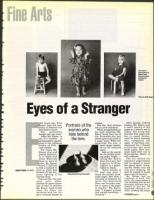

From left to
right, photos by
Elaine Yaker,
Marcia Boxman
and Nanette
Carnick
Photo by Beth Singer
Eyes of a Stranger
ght years ago, Dina
` :s i Kawer
took the sim-
licity of Polaroid and
presented it as art.
Her instructors
thought she was crazy.
Today Ms. Kawer is
,one of a handful of
photographers special-
izing in the technique
known as Pola-
roid transfer.
For years, Ms.
Kawer shot and
printed exclusive-
ly in black and
white. When she
hose to move to
olor, Ms. Kawer
found it difficult
to find a medium to
print on which best
showed off the dra-
matic lighting of her
still-life shots.
Polaroid film, the peel-
away party photo,
allowed for great satura-
tion of color. In addition,
Ms. Kawer could manip-
ulate the film's wet
emulsion with her fin-
gers, creating images on
Portraits of the
women who
hide behind
the lens.
c
LESLEY PEARL STAFF WRITER
Polaroid transfer by Dena Kawer
images.
One day, that wetness
led to a new technique.
While straightening up
her work materials, Ms.
Kawer found that one of
the Polaroids she had
peeled apart had stuck to
a paper towel. When she
separated the two, a
faint image remain-
ed on the textured
paper.
And so the search
for the perfect print-
ing paper began —
taking Ms.. Kawer
from Greene's Art
Supplies in Birm-
ingham to a paper-
maker in Japan.
"After months of
trial and error I
found the perfect hand-
made paper. But when I
returned to Greene's for
more, they discovered
there was no order num-
ber or name of the paper
to reorder," Ms. Kawer
said. "I stopped working
and started searching —
seriously."
After months without
success, Ms. Kawer sent
a small sample of the
paper to. a friend's son in
Japan. The young man
traveled from paper bro-
ker to paper broker,
until he found someone
who recognized the
paper. It had been com-
missioned for a French
printmaker and never
made again. How rem-
nants made their way to
Birmingham, Mich., is
still unknown.
The son located the
Japanese papermaker
and he agreed to create
the paper again, charg-
ing Ms. Kawer only his
cost plus shipping. He
said he wanted to break
down cultural barriers.
Ms. Kawer had an
explosion of work. She
wrote the papermaker a
note thanking him for his
assistance and sent him a
sample of her art. He
responded, offering to con-
tinue creating the paper
STRANGER page 46
cf,
cr) '
CC
•c:C
45