
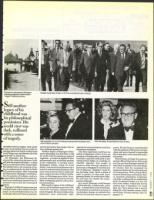

The home in Leuterhausen of Kissinger's
maternal grandparents, where he spent
" magical" childhood summers.
still another
legacy of his
childhood was
his philosophical
pessimism. His
world view was
dark, suffused
with a sense
of tragedy.
identified with his religion. Only partly
in jest, he grumbled that too much re-
porting about his family background
could "bring every anti-Semite out of the
woodwork" to attack him.
For Kissinger, the Holocaust de-
stroyed the connection between God's
will and the progress of history - a tenet
/- that is at the heart of the Jewish faith.
> For faithful Jews, the meaning of his-
tory is understood by its link to God's
[ will and divine justice. After witnessing
the Nazi horror, Kissinger would aban-
don the practice of Judaism, and as a
,young student at Harvard he would em-
bark on an intellectual search for an al-
ternative way to find the meaning of
\_history.
Kissinger's childhood experiences also
instilled in him a deep instinct of other
people. In his self-deprecating way, he
would joke about his famous paranoia
L
r
Kissinger as secretary of state: In 1973, the most admired man in America.
With Golda Meir: For him, the Holocaust destroyed the link between God's
will and history's progress.
and his perception that people were al-
ways plotting against him.
Another legacy of Kissinger's Holo-
caust upbringing was that later in life
he would avoid revealing any signs of
weakness - a maxim he applied to him-
self personally and, as the basic premise
of his realpolitik, to foreign policy.
Kissinger's father, whom he loved
deeply, was graced by gentleness and a
heart of unquestioning kindness. But
such virtues served only to make him
seem weak in the face of Nazi humilia-
tions. As Kissinger grew older, he re-
peatedly attached himself to forceful,
often overbearing patrons with power-
ful personalities.
Still another legacy of his childhood
was his philosophical pessimism. His
world view was dark, suffused with a
sense of tragedy. He came to believe that
statesmen must continually fight
With wife, Nancy: An assimilationist since his teens.
against the natural tendency toward in-
ternational instability.
The Nazi experience could have in-
stilled in Kissinger either of two ap-
proaches to foreign policy; an idealistic,
moralistic approach dedicated to pro-
tecting human rights, or a realistic, re-
alpolitik approach that sought to
preserve order through balances of
power and a willingness to use force as a
tool of diplomacy. Kissinger would fol-
low the latter route. Given a choice of
order or justice, he often said, para-
phrasing Goethe, he would choose order.
He had seen too clearly the conse-
quences of disorder.
As a result, Kissinger would become
- philosophically, intellectually, politi-
cally - a conservative in the truest sense.
He developed an instinctive aversion to
revolutionary change, an attitude that
affected his policies when he came to
power. He also became uncomfortable
with the passions of democracy and pop-
ulism and never learned to appreciate
the messy glory of the American politi-
cal system.
Nonetheless, perhaps the most im-
portant effect of the honors of his youth
was the one that Kissinger himself al-
ways cited: it instilled a love of his adopt-
ed country that far surpassed his
occasional disdain for the disorderliness
of its democracy. When young Heinz
reached Manhattan and became Hen-
America's combination of tolerance
and order would provide an exhilarating
sense of personal freedom to a boy who
had never before walked the streets
without fear, "I therefore," he would
later say, "have always had a special
feeling for what America means, which
native-born citizens perhaps take for
granted." ❑