
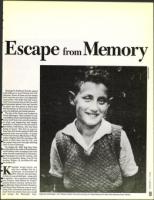

Courtesy of Paul Kissinger
Escape from Memory
Kissinger's childhood friends regard
such talk as an act of denial and self-
delusion. Some of them see his escape
from memory as a key to his legendary
insecurities. The child who had to pre-
tend to be someone else so that he could
get into soccer games, they say, became
an adult who was prone to deceit and
self-deception in the. pursuit of accep-
tance by political and social patrons.
The rise of the Nazis was hardest on
Paula Kissinger. Her husband Louis
was baffled, almost shell-shocked, struck
mute, but Paula was acutely sensitive
to what was happening and deeply
pained by it. Paula was very devoted to
- her father, Falk Stern, who was then
dying of cancer. She did not want to
leave him. But by the spring of 1938, she
realized there was no choice. A cousin
of hers who lived in Manhattan's Wash-
ington Heights filed the necessary affi-
davits to allow them into the U.S., and
the papers had come through allowing
them to leave Germany.
On August 20, 1938, less than three
months before the mobs of Kristallnacht
would destroy their synagogue and most
other Jewish institutions in Germany,
the Kissingers set sail for London, and
then on to America. Henry was 15, his
brother, Walter, 14, his father 50, and
his mother 37.
-
issinger would return, not
only as a soldier but as a
statesman. In December of
1975, when he was secretary
of state, he was invited back — along with
`=his parents — for a ceremony awarding
him Fiirth's Gold Medal for Distin-
guished Native Citizens. German For-
Minister Hans-Dietrich Genscher
and Mayor Kurt Scherzer were on hand,
along with a thousand onlookers and a
choir from the school that once would
not accept the Kissinger boys.
Eight-year-old Kissinger, 1931: Bookish; studied Torah every morning; and risked beatings from Nazis when attending soccer matches.