

d Silences
s on listening to survivors.
ELIZABETH APPLEBAUM ASSISTANT EDITOR
last for 10 weeks. It is
the first of its kind to
combine the skills of a
historian and a psycholo-
gist.
"It feels
almost like
learning a new
language."
THE D ETRO IT J EWIS H NEWS
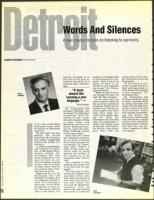
Henry Greenspan
t isn't only words Hank
Greenspan hears when
he listens to Holocaust
survivors.
He also hears the long
pauses, the stories
repeated ad nauseam,
the sudden, inexplicable
stops in the middle of a
narrative.
A clinical psychologist
and lecturer at Univer-
sity of Michigan Resi-
dential College, Dr.
Greenspan has been
doing research for the
past 15 years on sur-
vivors of massive psychic
trauma. Now he is about
to teach others what he
has learned about hear-
ing those survivors.
Beginning Jan. 21, Dr.
Greenspan and U-M
Dearborn Professor Sid-
ney Bolkosky will offer a
class "On Listening to
Survivors" at the Hillel
Foundation in Ann Ar-
bor. The course, which is
open to the public, will
Dr. Greenspan and
Professor Bolkosky, who
developed the Holocaust
curriculum "Life Un-
worthy of Life," spent
this past summer writing
a paper about how
Holocaust survivors are
heard. Spontaneously,
the two raised the possi-
bility of offering a course
on the same subject.
Some hold the notion
that Holocaust survivors
do not want to discuss
their lives because it's
too painful, Dr. Green-
span said. "That's a
myth. In fact, many sur-
vivors want to speak
despite the burden. If
the listener is at all
interested, they want to
talk."
The problem is that
listeners don't know how
to do their job, he sug-
gested.
The first step is over-
coming the listeners' own
prejudices. Often, they
come with a preconceived
idea about the kinds of
men and women who
survived the Holocaust,
regarding them all
heroes who utter nothing
but words of profound
wisdom, or treating talks
as psychoanalytic ses-
sions. "And a lot of us
think we know it all
already so our responses
are so pat," Dr. Green-
span explained.
"What we have to do is
cut through all that," he
said. "It's like a jungle."
At the same time, lis-
teners must be aware of
the survivors' particular
situations. Theirs isn't "a
typical oral history be-
cause people talk about
what they need to,"
rather than simply stat-
ing the facts, Dr.
Greenspan said. Not that
facts are unimportant —
rather, the listener must
be familiar with histori-
cal details, then juxta-
pose that with the
Hank
Greenspan
unique tale of how a sin-
gle individual survived
the tragedy.
"If you listen to sur-
vivors enough and do it
hard and long enough, it
feels almost like learning
a new language," Dr.
Greenspan said.
Dr. Greenspan and
Professor Bolkosky hope
to teach listening skills
by using audiotapes and
videos and through face-
to-face interviews with
local survivors. Topics
will include remember-
ing life before the
Holocaust, helplessness
and resistance among
victims and onlookers,
the experiences of libera-
tion and loss, and sur-
vivors' response to their
own aging. ❑