
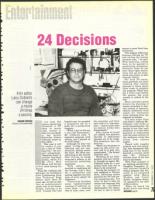

ainalec.
24 Decisions
Film editor
Larry Coblentz --
can change
a movie
24 times
a second..
SUZANNE CHESSLER
SPECIAL TO THE JEWISH NEWS
f you scan the
names appearing
whenever a TV
show or movie
ends, sooner or
later you are likely
to see former
Detroiter James
Coblentz listed as
film editor.
This year it will
be sooner if you
are a fan of "Life
Goes . On," his cur-
rent assignment.
"Quantum Leap" is
another television
credit, while It's
My Turn, Holy
Moses and Streets
of Fire rank among his
movies.
When Mr. Coblentz left
Michigan for California
after graduating from
Cass Technical High
School more than 20
years ago, he had no idea
that an entertainment
career was in his future.
Simply wanting to be
with friends who had
headed west, he accepted
a temporary job as a
gofer for a production
company.
"When I got on the set,
I was just fascinated,"
Mr. Coblentz said. "I
assisted someone with
editing, and I learned as
we went along."
Although he also was
asked to help with the
lighting and set con-
struction, editing meant
the most. He liked con-
centrating on the activity
that strives to bring
everyone's efforts to an
artistically satisfying
conclusion.
"Film editors are
involved in analyzing all
the footage that's shot
for a production and
putting together the best
parts of every scene," he
explained.
"There'll be multiple
takes (uninterrupted
running of cameras) on
every scene — shooting
that is wide, close, over-
the shoulder and from
each side of a conversa-
tion — and we pick what
we believe works best
dramatically."
After layers of sound
are added, the director
decides if additional
changes are to be made.
The producer has the
final say.
"There are 24 places to
make an edit every sec-
ond, and so it gets very
complicated, " the former
Detroiter said.
Working as an inde-
pendent and just recent-
ly through an agent, Mr.
Coblentz looks for a new
project each time one is
about to be completed.
During the summer, he
was assigned to Warner
Bros., converting motion
pictures for TV and air-
line presentations. For
some, he had to take out
scenes and language that
could be considered
objectionable. For others,
he had to add or delete
scenes to meet fixed time
allotments.
"The biggest difference
between editing for TV
and editing for movies
involves time, " he said.
With television, scenes
have to be geared to
established schedules.
Features films do not
have these tight restric-
tions and can be struc-
tured more freely to offer
dramatic effects.
For each TV series,
there generally are three
rotating film editors
because it takes about
three weeks to complete
one program. While they
get a head start before
the season, the work
usually is rushed at the
end.
Since economic goals
dictate the shooting of
scenes according to loca-
tion instead of sequence,
editors constantly- must
watch for continuity
when changing from one
segment to another.
I've seen major films
with flaws," reported Mr.
Coblentz, who works to
avoid inconsistencies. He
checks to see that each
performer is in the same
position or continuing
with the same activity as
the audience views the
action from various
angles.
Faced with lengthy
projects and ever-emerg-
ing, new equipment that
keep him in the studio
beyond a normal work
day, Mr. Coblentz
devotes most of his free
time to his family.
Wife Tish Lampert is
an aspiring screenwriter.
Daughter Cassandra, 17,
who entered Cornell's
drama program this fall,
acted in an animated
special with Henry
Winkler and Carrie
Fisher. Daughter Alexa,
13, appeared in the choir
of Home Alone.
When he heard the
Hoffa movie was being
DECISIONS page 89