
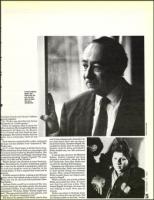

Ernest Fontheim,
above, and
Stella after the
war, her hair
shorn to show
she was a
collaborator.
• ermitted Jewish and "Aryan" children
study together.
Mr. Wyden also describes his former
choolmate as "a little spooky."
Stella, he explains, liked to shock her
ellow students. She brought Erich Maria
emarque's All Quiet on the Western
ront to school and read aloud the sexi-
passages. She told her teacher that her
ather was a communist, which he was
ot.
Such behavior among dutiful, polite, restrained
German Jewish children was "unheard of," Mr.
yden says.
At 17, as the Nazis began to fortify their power,
Stella sometimes found work as a jazz singer with
six-piece band headed by Manfred Kubler. She
performed Cole Porter and Hoagy Carmichael hits,
a repertoire including "Jeepers Creepers" "St. Louis
Blues" and "Me and My Shadow."
Stella's family was reluctant to leave Germany.
,Mter Kristallnacht, Gunther Goldschlag applied
ifor a visa, but he refused to immigrate unless he,
his wife and daughter could go together to the
United States. It was a request that would not be
granted.
So Stella stayed in Berlin, working at the Siemens
factory where she helped produce electric motors.
"When she was 19, she married bandleader Man-
q'red Kubler.
Perhaps Stella would have continued this way,
another pretty girl who fades gently into the past,
remembered fondly, if only vaguely, by former ac-
quaintances. "Of course, Stella," friends might have
said. "She was quite beautiful, a nice soprano, a bit
naughty. Whatever happened to her?"
But then in the spring of 1943 Stella, who by then
0
O
a-
was living underground, chanced to be
on a busy street where she ran into an
old Jewish friend, Guenther Rogoff. He
confided to Stella that he made false
identity cards for Jews, and asked if
Stella needed one, too. She welcomed
the offer.
It was too late, however, for Manfred
Kubler. Stella's husband had been
shipped to Auschwitz, where he died
two weeks later. Soon after, Stella took
up with the dashing Rolf Isaalcson.
Standing one afternoon outside the
Cafe Bollenmuller, Stella was surprised
to find herself facing two Gestapo
guards. They wanted identification.
Stella handed them her forged card,
made by Rogoff.
Within seconds, the guards grabbed
Stella and carted her away. It wasn't
just that the card was a fake. They
wanted Rogoff, the forger, the man who
was helping so many Jews pass as
Aryans.
Stella was taken to Gestapo head-
quarters where she was tortured, "left
as a bloody puddle on the floor," author
0,
cs,
w
co
2
w
LLJ
15