

Community Views
Editor's Notebook
Intergroup Relations:
Community Priority
Unlawful Entry:
Violence Intrudes In Our Lives
'DAVID GAD HARF SPECIAL TO THE JEWISH NEWS
GARY ROSENBLATT EDITOR
-
No group in
America is more
concerned about
its image and
relationships
with outside
groups than the
Jewish commu-
nity. While the substance and
• uality of those relationships
have ebbed and flowed, this
outward focus has been a con-
stant ever since Jews arrived
in America in significant
numbers in the early 20th
century.
The reasons for our concern
about our ties to other groups
are clear. For most of this cen-
tury, Jews lived in urban
neighborhoods among other
ethnic and racial groups, with
whom we shared minority
tatus and often acted as
rivals for scarce economic
resources.
As the Jewish community
gained political sophistica-
tion, we concluded that our
public policy goals could only
be achieved through coali-
tions of like-minded groups.
4'he civil rights coalition of
the 1950s and 1960s is the
classic example of such a
-coalition.
Times have changed, bring-
ing into question whether in-
tergroup relations continue to
_represent a relevant and use-
ful strategy for the American
newish community. For the
most part, Jews no longer live
in the cities; we, like the ma-
jority of Americans, now
reside in suburban areas and
are more widely dispersed
than ever before.
t , The clear-cut social issues
that involve a consensus by a
broad-based coalition of
minority groups seem absent.
As the relative gap between
the levels of affluence bet-
ween Jews and other minori-
ties seems to grow, it is more
L difficult to construct local or
national coalitions.
Paradoxically (or perhaps
not), concern is growing about
anti-Semitism in the African
American community and
elsewhere. Perhaps it should
'come as no surprise that as
the Jewish community finds
itself more distant, physically
and socio-economically, from
other racial and ethnic
minorities, stereotypes and
( bigoted attitudes take hold.
( TT' I believe the Jewish corn-
munity is mistaken if we
believe that intergroup rela-
tions are passe and un-
necessary. We should re-
L commit ourselves to building
.
links with other groups, not
David Gad-Harf is executive
director of the Jewish
Community Council.
just to forestall anti-
Semitism, for this reason
alone will only meet with
defensiveness and accusa-
tions of racism.
Instead, the Jewish com-
munity has clear, self-
interested, constructive
reasons. First, a significant
proportion of the Jewish com-
munity, here and elsewhere,
reside in diverse areas. Jews
living as neighbors with
African Americans, Arab
Americans, Asian Americans,
and others, have good reason
to seek alliances with these
groups to collaborate on
shared local concerns.
The Jewish Community
Council has joined the
Neighborhood Project in laun-
ching such an alliance, the
Southfield/Lathrup Multicul-
tural Coalition. This coaliton
brings together community
groups, city government and
the school district to address
local issues collectively. When
Perhaps the
most frighten-
ing aspect of
the increasing
violence in our
society is how
we get used to it,
accepting fear
and crime as part of our dai-
ly lives.
When I discovered that the
back window of my car had
been shattered in my
driveway one day last week,
my initial reaction wasn't
anger. I was relieved that
nothing had been stolen
from the car. I never even
thought to call the police.
What would they do, other
than file a report? I simply
had the window replaced,
paid the bill and considered
myself fortunate.
Gom zu l'tova goes the
Yiddish expression. Lit-
gest some story ideas and
discuss that day's Torah por-
tion.
He was sharp and articu-
late and in good health. "He
could have lived to be 97,"
his widow said wistfully the
day I visited. What was
remarkable is that he refus-
ed to retire and kept his job
as a salesman, driving
around downtown each
weekday, giving his
customers personal atten-
tion because he was a people
person.
Standing in the den of his
apartment, which was being
used as the room for services
during shiva, I noticed the
newspaper articles he had
clipped and a copy of Bob
Woodward's The Com-
manders, a study of the U.S.
military's preparations for
the Persian Gulf War, that
"We should
re-commit
ourselves to
building links with
other groups."
these efforts improve our rela-
tionship with our neighbors,
and when the communities in
which we live are enhanc-
ed, we benefit.
Second, we need to increas-
ingly recognize the inter-
twined nature of the cities
and their suburbs, and there-
fore the necessity of finding
ways to work with urban-
based groups for the common
welfare. A metropolitan area
characterized by a distressed
urban core, and by animosity
between communities, will
exact a price.
Jews have a stake in the af-
fairs of the entire metropoli-
tan area, including the city of
Detroit. The individuals
holding positions of power in
city and county government
should consider the Jewish
community as a significant
factor in its own right and as
a participant in coalitions for
progressive public policies.
The Jewish Community
Council has increased its
focus on city-suburban rela-
tions and local government
relations to ensure that
Jewish interests are well-
represented. To do otherwise,
would deprive us of oppor-
tunities to help make our
neighborhoods and the whole
metropolitan area more con-
ducive to Jewish life. El
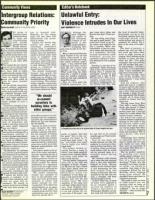
A Chasidic boy cries next to his injured father in Crown Heights last year.
erally, it means "also this
for good," but in the ver-
nacular it's closer to "it
could have been worse." As
in, "you broke your arm?
You're lucky you didn't
break both."
The broken window oc-
curred during a week in
which I was made painfully
aware of how violence affects
our lives, even when we
don't think about it.
The day before I had paid a
shiva call to the wife and
daughter of Frank Altman,
an 88-year-old man whose
fatal heart attack after be-
ing mugged in downtown
Baltimore made the
headlines of the daily pa-
pers. I had come to know Mr.
Altman well over the last
several years. We were
members of the same shul
and had a little ritual of our
own. Each Shabbat after
services, he would come over
to me and critique the cur-
rent issue of the paper, sug-
he had lent to me several
months ago and I had recent-
ly returned.
Now he was dead and
buried because he had the
audacity to continue to func-
tion as if this was still a city
of civility, where an old man
could believe that he would
not be pounced upon on a
crowded street during
daylight.
Mr. Altman's wife showed
me a letter she had received
from a man who identified
himself as black, offering
comfort to the victim's fami-
ly and bemoaning the fact
that human lives had
become so devalued. She was
touched by the fact that the
man, a stranger, had been
moved enough to write.
In New York City, at least
we know we're supposed to
be on constant guard. I
visited my nephew at
Yeshiva University in
Washington Heights one day
last week and was amazed at
the level of security there.
Everywhere you go on the
four-block campus there are
uniformed guards with
walkie-talkies and plenty of
questions for visitors. It's a
pain in the neck, yet comfor-
ting.
The head of security, a
retired cop, told me that a
few years ago there were
seven or eight guards on
campus. Now, because of the
increase in crime, and fear,
there are 120. "You gotta
remember that this precinct
had 134 murders last year,"
he said breezily, "and that's
more than a lot of good-sized
cities. I can't remember the
last time it was under 100."
He noted, though, that
most of the murders are
drug related. I was little
comforted.
And my nephew, who
spent last year at a yeshiva
in Israel and felt safe there,
said he is often afraid travel-
ing in New York and would
not wander a block off cam-
pus unprotected. His friends,
virtually all of whom have
studied in Israel, feel the
same way.
Driving home from New
York with a native Mahat-
tanite who moved to Israel
— the West Bank, no less —
several years ago, I ask him
where he is more afraid. No
contest, he says. America.
So while we read of
fearless Israelis subjected to
stoning on the roads of the
territories, these same
Israelis read about Ameri-
can women taken from their
cars in suburban shopping
malls and murdered. Who is
more brave, who more
foolish?
Car jackings have shaken
us especially because we
used to think that we were
safe inside our cars, that
they were an extension of
our homes. Well they are —
and neither is safe.
But we protect ourselves
by growing ever more
callous about violence. A 4-
year-old killed in the cross-
fire of a drug-related
shooting? Tragic, but she
shouldn't have been outside
at night, we think to
ourselves. And what of the
youngster killed for his
Reeboks while walking
home from school? He
shouldn't have worn them to
school,-we conclude.
The truth is that we have
so little control over our
security that we keep on
whistling in the dark,
saddened — but no longer
shocked — when we hear of a
UNLAWFUL page 8
-