

Sharing Stories
LESLEY PEARL
STAFF WRITER
Authors tell the
personal and
professional at the
41st annual
Jewish Book Fair.
■■■
omen of all ages
gathered togeth-
er Nov. 17 at the
Maple-Drake
Jewish Community Cen-
ter to learn and support
each other in, the trials
and tribulations of infer-
tility.
Authors Lynne Sipiora
and Barbara Shulgold
told about the creation of
their book Dear Barbara,
Dear Lynne — a compila-
tion of letters between
the two women since
1984.
Ms. Shulgold, in her
late 30s then, wrote a
letter at 4:45 a.m. to the
National Resolve News-
letter — a publication for
couples struggling with
infertility. She wrote of
her sadness and need for
support as she dealt with
fertility drugs and pain-
ful exploratory surgery.
Lynne Sipiora, living
in Wisconsin then, was
moved by the words and
responded to Ms. Shul-
gold's plea. And a friend-
ship formed through the
mail.
Ms. Shulgold and her
husband had already
begun the process of
open adoption.
She shared the trauma
of a Texas schoolteacher
who changed her mind
and decided to keep the
baby; of a couple that
wanted the Shulgolds to
move them to California,
pay their rent, utilities,
and find them a car in
exchange for their child
(they turned them down);
of a baby they took home
with them only to have
the birth mother change
her mind five days later
and take her child back;
and finally, her contact
with Lilly in Indiana-
polis who gave birth to
Miriam — the Shulgolds'
6-year-old daughter.
The Shulgolds adopted
their daughter Leah in
1989. Her natural moth-
er's name was Destiny.
"And how could we
turn our backs on
Destiny?" Ms. Shulgold
asked.
Ms. Shulgold served as
Ms. Sipiora's mentor,
one-and-a-half years
ahead of her in the adop-
tion process. Ms. Sipiora
and her husband also
chose open adoption,
dealing with the same
W
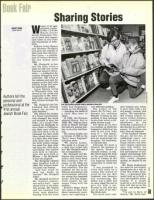
Pam and Caroline Kowatch make a selection at Book Fair.
leads and disappoint-
ments as the Shulgolds
— including the death of
a child they were to
adopt.
In 1988, the Sipioras
adopted Kenny. And in
1992, Ms. Sipiora gave
birth to Daniel through
the help of a process sim-
ilar to in-vitro fertiliza-
tion.
The women finally met
in October of 1992 on the
"Sally Jesse Raphael"
television show.
"We shared deaths.
The death of a dream of
a child that looked like
me," Ms. Shulgold said of
the correspondence.
Ms. Shulgold and Ms.
Sipiora also shared sta-
tistics with their Book
Fair audience. For in-
stance, in the 1950s one
in 10 couples suffered
from infertility. Now the
numbers are one in six.
Delayed parenthood and
environmental pollution
are among the suspected
causes. And they empha-
sized support for any
couple living with the
problem.
Rochelle Majer Krich
also spoke at Book Fair
about community assis-
tance, but regarding a
very different problem.
The author of Till
Death Do Us Part ad-
dressed the audience
Monday evening on the
problem of men refusing
to give their wives' a reli-
gious divorce or get.
Till Death Do Us Part
is a mystery in which the
husband is killed but his
wife is not sure "who
done it" — her father,
angry with the man for
how he mistreated his
daughter, her boyfriend,
or someone else.
Although the book is
fictional, the question of
the aguna, bound or
chained woman, is real.
Ms. Krich based the book
on the real-life experi-
ences of women in the
Los Angeles Orthodox
community in which she
lives.
"I was prompted to
write this story by a
woman who waited 10
years for her get. Her
husband was abusive
and overbearing. His
father was a rabbi and
he even urged the son to
give his wife a get.
Finally he did. But she
lost 10 years of her life,"
Ms. Krich said.
The three most corn-
mon reasons men refuse
to give their wife a get
are money, custody and
malice. The implication:
the woman cannot re-
marry within Judaism
and is considered an
adulteress by the
Orthodox community if
she marries in a civil cer-
emony. If children are
born, they are bastards.
If the husband refuses
the get, the bet din, or
rabbinical court, can
greet him with a con-
tempt citation and then
later impose sanctions
upon him within the
community — denying
him participation in syn-
agogue and dealings with
community merchants.
This rarely happens
quickly, as implied in the
novel.
Ms. Krich emphasized
the need for pre-nuptial
agreements as a way to
avoid this sticky situa-
tion — a document that
would hold up in both a
civil and halachic arena,
stating if a couple
receives a civil divorce
they will also go to the
bet din and accept their
ruling.
"I'm not in favor of
divorce," Ms. Krich said.
0)
C
CC
U_J
w
59