

INFORMATIONAL
MEETING
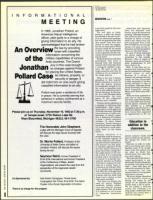
In 1985, Jonathan Pollard, an
American Naval intelligence
officer, pled guilty to a charge of
giving information to an ally. He
acknowledged that he had broken
the
l
a
w
by
provi
d
i
n
g
An Overview Israel with classified
information concerning the
military capabilities of various
Arab countries. The Grand
Jury in this case brought
no charges against Pollard
for placing the United States,
its citizens, property, or
ollard Case security in danger. It
did indict him on one count: giving
classified information to an ally.
of the
Jonathan
P
Pollard was given a sentence of life
in prison. He is currently serving that
sentence in solitary confinement at a
maximum security facility.
Please join us on Thursday, November 19, 1992 at 7:30 p.m.
at Temple Israel, 5725 Walnut Lake Rd.
West Bloomfield, Michigan 48323, 661-5700
The Honorable John Shepherd,
Judge with the Michigan Court of Appeals
will discuss the legal issues involved with
the case.
Dr. Morris Pollard, Professor at the
University of Notre Dame and father of
Jonathan Pollard, will discuss the issues
facing his son.
Seymour Reich, former President of
B'nai B'rith International and former President
of the Conference of Major Jewish
Organizations, will present the case from the'
perspective of the organized Jewish
community.
C/3
w
CID
Co-Sponsored by:
CC
I-
LL!
LU
F-
8
Adat Shalom Synagogue, Temple Israel,
Congregation Shir Tikvah, B'nai B'rith, The Detroit
Chapter of the Zionist Organization of America
There is no charge for this program
EDUCATION
page 7
to get Seth ready for this new
experience."
The real topic at hand,
however, is after the family
has decided to become involv-
ed in an educational package,
how do we maximize the time
they spend? Once they have
chosen to enter the system,
how do we retain them? What
creature needs do we choose
to meet so that membership
in the organized Jewish com-
munity means more than just
paying dues?
Business seminars tell their
participants that more is
learned from lost business
and exit interviews than from
a thousand satisfied custo-
mers. We need to ask the
tough questions and then be
willing to try to respond to
the tough answers.
What is the role of family
education in this matrix?
Family education is meant to
help the family become
knowledgeable enough to see
the value in spending more
time in the classroom, and in
Jewish learning. As the fam-
ily as a unit becomes more
knowledgeable, the time
spent in the classroom
becomes more valuable.
Further, family education is
a strategy or technique that
complements other techni-
ques used in a wide spectrum
of Jewish learning. Although
some educators or rabbis may
specialize in family educa-
tion, it behooves all teachers
to have a family education
mindset. In every lesson
presented, Jewish educators
must think about what effect
the information could poten-
tially have on the entire
family.
Family education is a
strand that must be woven in-
to the complete tapestry of
Jewish education. By think-
ing about family education in
this manner, one also quick-
ly becomes cognizant of the
fact that family education is
much more than a single Fri-
day night dinner at the tem-
ple or shul. It is a continuing
process with a curriculum to
be shared. It is pa'rallel lear-
ning for parents on Sunday
morning, or cooperative lear-
ning on a timely basis in-
creasing as the kids get older.
It is a sundowners' program
that offers the working parent
a new adventure in the early
evening with his child with
dinner and a chance to chat
with peers provided.
This does not dismiss the
need for family Shabbat
weekends, holiday celebra-
tions and informal learning
opportunities. But, all of this
is in addition to, not in place
of, classroom instruction
time.
Americans and American
Jews are besotted with
choices, and pride themselves
on being "informed choosers."
The American (Jew) will read
volumes on where to travel,
what to eat, what to buy, and
how to play golf. Even in the
field of medicine, the average
layman will seek out the in-
formation he feels he needs to
make an informed choice.
In each of these instances
the person begins to take
ownership in the outside.
However, when it comes to
Judaism, many are willing to
allow professionals to tell
them what to do.
Still, it has been my ex-
perience that American Jews
can be interested in informed
Jewish choice as well.
Because of a variety of
reasons, the average Jew has
simply not been encouraged
to take ownership in his own
Jewish education or that of
his children. Informed Jewish
choice has simply not been of-
fered frequently enough.
Many never knew they had a
choice.
What we have neglected to
take note or what, perhaps,
has never really been pointed
out, is that there are exciting
Jewish options. Judaism can
offer stability in a world
changing so quickly that it is
difficult to fathom. How often
have mitzvot been explained
as opportunties to fill our
Education in
addition to the
classroom.
Jewish memory banks and
show our kids, by our actions,
the things for which we
stand?
However, in order to make
that a convincing case, whole
families need to be taught
about what the options are:
not what we think they
should know, but what they
are really asking.
We must look to the time in-
vested (particularly in sup-
plemental Jewish education)
as possible, well-spent family ,
time — time that does not
reduce the moments for fami-
ly interaction, but that
utilizes them in an enjoyable
informative manner.
We are no longer identified
by the families to which we
belong, but rather by the
things we do. Judaism has
always been a life of action.
We are indeed a show-me
society. Our challenge is to
help people understand that
Judaism has always been a
show-me heritage. El