

tion that will accept him. He showed_
the journalists a letter from Canadian
officials discouraging him from apply-
ing for refuge in that country.
Recently, Mr. el-Sheihk — a tall, black..
skinned man with a sophisticated air
— was walking back to the hostel from
the center of Potsdam when he was
jumped by a group of skinheads.
"They said, 'Give me your money.' I
replied that you must work if you want
money. They damaged my nose by knife.
I spent two weeks in the hospital," he
said in a shaky, emotion-laden voice.
When talking with the Jewish jour-
nalists inside the hostel, Mr. el-Sheihk
refused to condemn his hosts. What hap-
pened to him, he said, "does not mean -
that all German people are bad. In ev-
ery place there are good and bad people, I
even in Sudan," he said.
But minutes later, chatting with sev-
eral journalists outside the hostel, he
spoke with bitterness about how the po-
lice treated him as a criminal, not as a
victim, as he lay bleeding on the street ,
— and about how he was sorry he had
come to Germany.
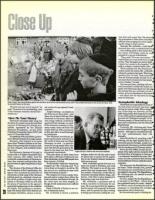
Never Forget: Jews demonstrating against anti-Sem itism at the former Sachenhausen camp, after it was partially destroyed by fires set by neo - Nazis. Jews
have placed flowers on the ruins.
"Events here are out of control," he
said. "It seems to be snowballing. And
if the German economy should fail —
watch out."
DE TRO I T J EW IS H N EWS
'Give Me Your Money'
UJ
10
Germany's resurgent right wing was
the focus of a recent, seven-day fact-find-
ing tour of Germany for Jewish jour-
nalists, sponsored by the Konrad
Adenauer Foundation — an arm of the
Christian Democratic Union (CDU), the
party of Chancellor Kohl.
In speaking with journalists, govern-
ment officials stressed two major points.
Germany, they argued, is no worse
than other Western nations in its han-
dling of the growing tide of asylum seek-
ers and refugees, and probably better
than most.
But Germany, because of its past, is
being held to a higher standard than
other nations, they added. And the
worldwide condemnation of German ac-
tions, they warned, could provide a dan-
gerous boost to right-wing forces in their
nation.
The director of the Federal Office for
the Protection of the Constitution, the
agency that monitors the activities of
extremists at both ends of the German
political spectrum, sketched a broad out-
line of the problem of right-wing radi-
calism in Germany when he met with
the group of reporters in the agency's
sprawling headquarters on the outskirts
of Cologne. The building is a modern,
high-tech facility filled with abstract art
and paper shredders, almost a movie-
set version of a spy agency's head-
quarters.
Jurgen Gohring — no relation to
the Nazi-era air force chief— said
there are at least 6,000 neo-Nazi
skinheads in Germany. Most are
very young, without a well-devel-
oped political ideology, he said.
If the economic pressure in Ger-
many eases, many of them will
simply drift out of the movement
as they get older, he said through
an interpreter.
The skinhead movement ap-
pears particularly attractive to
the youth of what was once East
Germany, he said — in part be-
cause the young people there who
once had futures guaranteed for
them by the state now face lives
Jurgen Gohring: Violence was worse than expected.
of economic uncertainty.
This year alone, he said, there have refugee; before he left his native land,
been about 1,000 acts of violence by neo- he spent time in prison for his opposi-
Nazi skinheads; at least 800 people have tion to the Sudan's Islamic fundamen-
talist government.
been injured, 10 killed.
Now, el-Sheihk spends his time in a
"In the last few weeks the violence has
stepped up," Mr. Gohring said. "It is state-run hostel in Potsdam, just west
worse than we thought it would be. We of Berlin. The hostel is an old day-care
are not yet in a position to cope with center that now houses some 103 asy-
lum seekers. Physically, it looks like an
these situations properly."
The targets have been mostly Gyp- American homeless shelter; dingy, util-
sies and asylum seekers from Africa, the itarian, with little touches designed to
Arab countries and Eastern Europe. So bring some color into drab lives.
Mr. el-Sheihk, a musician and oil
far, Jews have not been targets, al-
though Jewish institutions have suffered worker, has been in Germany for one
year. He is convinced that his applica-
vandalism.
Galal el-Sheihk of Sudan is one vic- tion for asylum will eventually be turned
down, and he spends his days writing
tim of skinhead racism.
Mr. el-Sheihk is clearly a political to foreign governments, looking for a na-
Xenophobic Ideology
Skinheads are responsible for most of
the bad press Germany has been re-
ceiving in recent weeks. More danger-
ous, in the long run, however, are the
right-wing parties that range from overt- _
ly neo-Nazi political organizations that 1
promote the "biological strength" of the
German people, to those that try to ap-
pear more mainstream, like the German
Republicans.
Currently, Mr. Gohring said, there
are some 40,000 members of right-wing
parties — although he conceded that fig-
ure may underestimate their real
strength.
Since World War II, according to Mr.
Gohring, the far-right parties have oc-
casionally gained strength, mostly dur-
ing economic downturns, and then faded
into the background of German society.
But in the mid-1980s, he said, the em-
phasis of far-right activism turned to the
growing influx of foreigners in Germany
— an economic headache for many Ger-
mans, but also a presence that reawak-
ened traditional German attitudes about
outsiders.
The issue gave the Republicans a ma-
jor boost. Under German law, parties
advocating non-constitutional means
are subject to banning. The Republicans,
Mr. Gohring said, are careful to avoid
crossing that line.
For now, support for the Republicans
is stronger in the West — where they
have operated openly for years — despite
the West's years of prosperity and its
emphasis on educating the younger
generations about democracy.
But the extremist party is finding fer-