
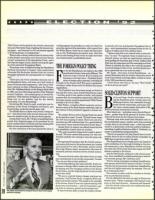

"Bill Clinton will be good for the Jewish community working against the president, as well; now that Con-
because of the better hope of getting the economy go- gress has approved the guarantees, with support from
ing again — and because he will not tolerate appeals the White House, there are no major flareups loom-
to dividing groups, to scapegoating."
ing on the Washington-Jerusalem axis. And that
There is also a strong undercurrent of concern with- seems to be freeing Jewish voters to make their deci-
in the Jewish community over the growing "family sion based mostly on pocketbook issues.
values" orientation of the Republican Party, and a
fear that the slogan is just a facade covering the agen-
da of the extremist Evangelical Right.
Those fears were multiplied during the Republican
National Convention in August, when conservative
or Jewish Republicans, the stakes in the 1992
columnist Pat Buchanan declared that the current
presidential election look quite different. The
campaign represents the opening battle of a "religious
battered corps ofJewish Bush loyalists are
war."
focusing on one basic issue — President Bush's
"There are a lot of very unhealthy elements now in
claim to foreign policy expertise, including his
the Republican Party, and some very bad trends in triumph in the Persian Gulf War and, in particular,
terms of church-state separation," said Larry Gold- creating a viable framework for Middle East peace
berg, national co-chair of Republicans for Clinton- negotiations.
Gore. Mr. Goldberg helped run the Reagan-Bush effort
The President may have been tough on Israel in
in 1980, and was a founding member of the National the past few years, some Jewish Republicans argue
Jewish Coalition — the central group of Jewish Re- — but they point to the positive results, and express
publicans. "This element of religious warfare is some- concern that the tremendous opportunity offered by
thing new in our politics, and for the Jewish the peace process would be jeopardized if Bill Clinton
community, it's very disquieting."
ascends to the Oval Office.
Re-electing Mr. Bush, he said, would give new le-
Max Fisher, a longtime Bush supporter and na-
gitimacy to the forces of religious extremism, and tional co-chair of the Bush finance committee, laid out
would further erode the church-state wall.
the essence of the president's appeal to Jewish vot-
The Middle East is a factor with Jewish "swing vot- ers.
ers" — that 30 percent of the Jewish electorate whose
"It's pretty obvious where George Bush has stood
votes are shaped mostly by the pro-Israel agenda.
for the past four years," he said. "We don't know where
Among these voters, Mr. Clinton is benefiting hand- the new man is going to stand. There are a lot of is-
somely from lingering anger at the president for his sues that are still undetermined. I'm a great believer
harsh condemnation ofJewish activists seeking $10 in the devil I know instead of the devil I don't know."
billion in loan guarantees last September.
George Bush, he argues, has offered Israel the first
But the resolution of the loan guarantee issue is real possibility of peace since its creation.
"The most important thing Israel needs is peace,"
he said. "We have started this process; I'm very wor-
ried that anybody new coming in can only cause a de-
lay."
He expressed frustration that the Jewish commu-
nity seems oblivious to this achievement as it makes
up its mind how to vote in November, and he worries
that a big Clinton victory among Jews will mean di-
minished political influence for the Jewish commu-
nity.
"It means that the other side doesn't have to make
any commitments to the Jewish community," he said.
"You can see that in their platform."
Jewish Republicans also argue that Mr. Bush's ex-
perience in foreign affairs makes him the best choice
for dealing with the changing realities in the former
Soviet Union, and the lingering threat to Jews in that
part of the world.
"We are in a period of grave danger and great op-
portunity," said Gordon Zacks, a longtime Bush sup-
porter and Jewish activist. "The people in the republics
of the former Soviet Union are experimenting with
democracy and freedom — and the transition is go-
ing to be an arduous, painful and prolonged one."
The Jewish community has not figured much in Ross Perot's largely
If that revolution fails, he said, the results will like-
THE FOREIGN POLICY THING
F
electronic campaign.
ly include civil war and disorder throughout the re-
gion — and a tremendously increased threat to the 2.5
million-3 million Jews who still live there.
"I believe that this is the critical factor in this elec-
tion," he said. "To negotiate these troubled and un-
charted waters, we need an experienced, seasoned
hand guiding the American ship of state. I believe that
Bush has the experience and the seasoning to do that.
Clinton is untested; the risks to the world are too great
to entrust things to this novice. And the Jewish peo-
ple in particular have too much at stake."
Mr. Zacks — like many Jewish Republicans — ex-
pressed frustration that the Jewish community seems
to have lost interest in foreign affairs, at least in terms
of the 1992 presidential contest.
"I don't know why this is," he said. "But I think
we do so at our own peril."
SOLID CLINTON SUPPORT
B
ut by and large, Jewish voters are not buy-
ing the Republican pitch. Concern about the
faltering economy has resonated strongly
in the Jewish community, and many Jew-
ish voters remain deeply distrustful of Mr.
Bush's personal commitment to Israel.
Most observers — including many Jewish Repub-
licans — predict that 80-85 percent ofJewish voters
will pull the lever for the Clinton-Gore ticket.
Because most Jews made their decisions early in
the presidential season, neither party has mounted
a major drive to win Jewish votes — a fact that could
result in a diminution of Jewish political influence,
according to political historian Allan J. Lichtman, an
expert in presidential prognostication.
"There's no question but that there's been a much
smaller focus on the so-called Jewish campaigns in
1992 than in previous years," he said.
The Republicans have simply given up, based on
early predictions of a thorough drubbing in the Jew-
ish community; many Republican Jewish activists
fear that this will severely limit their input into GOP
decision making in the future.
And the Democrats, seeking to craft a broad coali-
tion, have steadfastly avoided pandering to individ-
ual minority groups, Mr. Lichtman said.
"You're seeing campaigns avoiding identification
with groups perceived as special interest," he said.
"Clinton has scrupulously avoided any identification
with the civil rights community, for example. This will
be a continuing trend."
The results, he said, could be a decline in Jewish
clout in presidential contests.
But he added that this does not apply to House and
Senate races. "Those campaigns still depend much
more on the kind of power — electoral and financial
— that the Jewish community has traditionally been
able to bring to bear."