
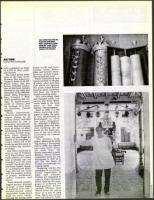

Left, tallitot hang from the
brass-and-wood pulpit.
Right, handtooled casings
house the Torahs. Below,
Caretaker Jackie Cohen
stands at the entrance.
JEW TOWN/
– have numbered as many
as 4,000 at their peak,
still survive.
The latter group dates
back to the time of St.
Thomas the Apostle's
voyage to India in 52 CE.
I Those Jews, like the
Syrian Orthodox Christ-
ians at that time, became
involved in the trade and
commerce of the Malabar
coast, King Bhaskara
Ravi Varman I (962-
1020) granting the vil-
lage of Anjuvannam,
north of Cochin, and
its revenue, to a Jew-
ish merchant, Joseph
Rabban.
Those concessions,
likewise preserved on
copper plates in an
ancient script, included
permission to use a
palanquin and parasol,
in those days the prerog-
ative of rulers, in effect
sanctioning the creation
of a tiny Jewish king-
dom. Upon Rabban's
death, his sons fought for
control of the kingdom, a
rivalry which led to its
break-up and the move to
its present day location
in Cochin.
Jew Town continues to
exist in one of Cochin's
still-flourishing spice
trade centers, in a scene
that probably has not
changed over the past
several hundred years:
Old firms huddle togeth-
er in dilapidated build-
ings, the hot air filled
with the pungent aromas
of ginger, cardamom,
cumin, turmeric and
cloves.
Dark-skinned spindly-
legged porters wrapped
in lungi—a short length
of material worn like a
sarong—strain under
impossible loads piled
high on erect heads,
heaving the burlap sacks
diesel trucks and worn
wooden carts. Motor
bikes and bicycles weave
between women swad-
dled in brilliant saris.
Small businesses and
homes painted in shades
of white, ocher and blue
that stand out against
the palm frond-dotted
tropical skies occasion-
ally bear an owner's
Jewish-sounding name.
Tiny curio shops, dark
and cramped inside, line
narrow Jew Town Road,
which leads to the focal
point of this tiny
enclave—the synagogue.
Built in 1586, it is the
oldest surviving syna-
gogue in India. An earli-
er one, constructed at
Kochangadi in 1344,
has since disappear-
ed, although a Hebrew-
inscribed stone slab from
that building can be
found on the inner sur-
face of the wall which
surrounds the current
structure.
The present syna-
gogue, destroyed by shell
-ing during a Portuguese
raid in 1662, was rebuilt
two years later. About
the same time, the
Dutch renovated nearby
Mattan- cherry Palace,
originally built by the
Portuguese in 1557 as a
gift for the Raja of
Cochin in exchange for
trading rights.
Stepping inside the
synagogue is an extraor-
dinary experience of
light and airiness.
Visitors are requested to
remove their footwear
before entering the syna-
gogue to preserve the
hand-painted, willow-
pattern Chinese tiles
which cover the entire
floor in a sea of pale
blue. Each one unique
and individually made,
P ho tog rap hs by Su san Roc k
continued from preceding page