

J e w
Town
SUSAN ROCK SPECIAL TO THE JEWISH NEWS
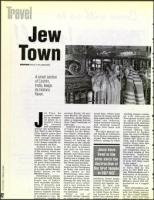
A small section
of Cochin,
India, keeps
its historic
flavor.
ew Town. An
unusual name
for an unexpect-
ed place in a
country where
the unusual
and unexpected
assume epic proportions.
Jew Town is one of those
little known gems that
India offers up to those
with enough patience
and fortitude to dig just
a bit deeper beneath its
ever-present red dust.
Tucked away in the
southwesternmost corner
of the country, where the
Indian subcontinent
reaches far into the
Arabian Sea toward the
equator, Jew Town leads
its quiet little existence
in the city of Cochin, in
the narrow, fertile strip
of a state called Kerala,
better known as the
Malabar Coast.
Something of a statisti-
cal surprise itself, Kerala
boasts one of India's
most equitable distribu-
tions of property and
income, relatively low
infant mortality and the
nation's highest literacy
rate thanks to a heritage
of progressive rule. Its
population, roughly 60
percent Hindu, 20 per-
cent Muslim, 20 percent
Christian, speaks Malay-
alam, a language derived
from Tamil hundreds of
years ago.
Isolated from the rest
of India and would-be
invaders by the West-
ern Ghats—formidable
mountains to the east—
Cochin has long had the
luxury of turning its
attention to the outside
world, across its shores
to the west. A commer-
cial port on the main
trade route between
Europe and China since
at least Roman times,
Cochin has a lengthy his-
tory of contact with both
the Orient and Occident.
Long before Vasco da
Gama led the Portuguese
to India, the coast had
been known to the
Phoenicians, who came
in search of spices, san-
dalwood and ivory, trans-
forming the area into an
important spice center
and a way station for
similar shipments from
the Moluccas, now east-
ern Indonesia.
Today a city of
850,000, Cochin remains
an important port and
naval base, whose main
sources of income include
ship repair and the tradi-
tional coir industry,
which involves weaving
and twisting coconut
fibers into mats and
rope.
The city's physical lay-
out stands as testimony
to its diverse internation-
al past. Best described as
eclectic, among its other
attributes, Cochin boasts
a series of Venetian-style
islands and lagoons con- .
nected by boat and
bridge; India's oldest
European-built church,
in which Vasco da Gama
was buried for 14 years
before his remains were
shipped back to Lisbon;
winding streets cramm-
ed with 500-year-old
Portuguese houses and
an equally old palace
decorated with elaborate
murals of the Ramayana;
Chinese-style canti-
levered fishing nets
introduced by traders
from the court of Kublai
Kahn, dangling over the
harbor like sails in the
wind; and a Jewish com-
munity whose roots date
back over 3,000 years.
Although scholars are
not completely clear in
the exact origins of this
seemingly misplaced
enclave, they do know
that two distinct groups
of Jews left their mark
on the region.
Black Jews are said
to have fled to the
area in 587 BCE dur-
ing Nebuchadnezzar's
destruction of Jerusalem,
according to an inscrip-
tion by the Prince of
Malabar dated 388 CE,
preserved on a copper
plate.
Their descendants sub-
sequently intermarried
with the Hindu popula-
tion, but a small number
of the later-arriving
"white Jews." who rn