

La Malaise Montrealaise
If Quebec secedes from Canada after an
Oct. 26 constitutional referendeum, 40
percent of Vontreal's Jews may leave.
GIL KEZWER SPECIAL TO THE JEWISH NEWS
T
he
id9g07010
a3;
DQuebec's
Jews — almost all of
whom live in Montreal
— falls twice this year. The
first came last week Yom
Kippur; the second comes in
10 days when Canadians
vote on a constitutional
reform package known as
the Charlottetown Accord.
A "yes" vote in the Oct. 26
national referendum — the
first since 1942 and the third
in Canada's 125-year history
— means greater autonomy
for the Francophone prov-
ince of Quebec, revamping
the largely ineffectual na-
tional senate in the capital
of Ottawa, and enhanced
rights for native peoples. A
"no" decision could seal
1
Quebec's secession from the
country's 10-province fed-
eral system.
A recent study by Mon-
treal's CRB Foundation de-
termined that if Quebec
seceeds, 40 percent of Mon-
treal's Jews may leave.
Weary of the perennial
wrangling over language
„ rights and the harsh laws
designed to preserve the vis-
age linguistique that non
Quebecois pure lain (dyed in
--, the wool French Quebecers)
complain have reduced them
to second-class citizens,
many English-speaking
Jews have already voted
—with their feet. About
40,000 Jews (and another
300,000 Anglos) have quit
their beloved belle province
since the pro-independence
Parti Quebecois was first
elected in 1976.
The slow exodus has been
helped along by teens pursu-
ing post-secondary education
in Ontario, the United
States and Israel, and by
university grads who take
jobs outside the province.
This has produced a Jewish
population with a gaping
hole in the 25-to-40 age
bracket.
The Canadian Jewish
Congress (CJC), Com-
munaute Sepharade du
Quebec and Montreal's Jew-
ish Federation have made
community continuity and
youth retention their top
priorities, said Michael
Crelinsten, executive direc-
tor of the Quebec region of
CJC, the umbrella for
Canada's 330,000-strong
Jewish community. On-
going meetings with Mon-
treal Mayor Jean Dore, he
added, seek to find strategies
to persuade teens to remain.
Toronto has not only
eclipsed Montreal as
Canada's financial
powerhouse; it is now also
the country's center for Jew-
ish life. Montreal had held
that twin status since the
capture of the Bourbon col-
ony of New France by
Britain in 1759.
Symbolizing Jews' flight
from Quebec was the State of
Israel Bonds' national office
move last year to Toronto
from Montreal, where it had
been since 1953 when Bonds
was founded in Canada. And
Professor Ruth Wisse, a
notable scholar of Yiddish
literature, is preparing to
leave McGill University's
Department of Jewish
Studies for a newly-tenured
Many Montreal
Jews are wary of
French Quebecers'
xenophobic
nationalism.
chair in her specialty at
Harvard.
Rumors were afoot at
CJC's 23rd plenary in May
about whether — and when
— it would also quit its na-
tional headquarters in Mon-
treal. But with the referen-
dum looming, few were
eager to discuss a move that
could jeopardize the
precarious position of the
province's Jews.
Despite the attrition, fund
raising for local and Israel-
based causes has not declin-
ed. Such institutions as the
Jewish General Hospital
and the Jewish Public
Library are still well sup-
ported, while the Golden
Age Association is a model
to the world for how to re-
spond to senior citizens'
needs.
Montreal's Jews and
Canada's entire Jewish
community have solidly
backed the proposed con-
stitutional reform and the
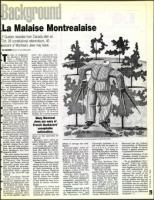
Artwork by D. B. Johnson. CopyrightC 1991, D. B. Johnson. Distributed by Los Angeles Times Syndicate.
efforts to salvage ties with
Quebec.
Interestingly, most of
Montreal Jews are func-
tionally bilingual; and all of
the 6,000 students in the
city's Jewish day schools
study French, English and
Hebrew. Some also study
Yiddish. In Canada, edu-
cation is a provincial con-
cern, and 80 percent of Mon-
treal's Jewish day schools'
budget comes from the
Quebec government.
Despite that largesse,
many Montreal Jews are
wary of French Quebecers'
xenophobic nationalism, a
movement that has tradi-
tionally veered into anti-
Semitism.
"Several years ago, I had
to decide whether to stay or
go somewhere else," said
Jim Torczyner, a McGill
University professor of so-
cial work and an expert on
Canadian Jewish
demography. "It's tiring to
deal with the petty nastiness
of the legislation around
signs. There's a feeling of
clearly being second-class in
Quebec."
The New York-born Torc-
zyner decided to remain, but
he is always looking over his
shoulder, so to speak.
"My God," he said, "if my
parents had felt the same
way in Vienna, I wouldn't be
here. They got out just in the
nick of time. I'm not compar-
ing Quebec to Nazi Ger-
many. But the issue is the
same. It makes you wonder:
Is it possible to co-exist in
this society or should I pack
up and leave? We Jews know
the consequences of guessing
wrong. Particularly because
Montreal has the highest
concentration of Holocaust
survivors outside of Israel,
there's a special sensitivity
to nationalist sentiment."
Michael Crelinsten of the
Canadian Jewish Congress
also cautions against panic.
"As an Anglophone Jew,"
he said, "I feel very comfor-
table in Quebec. No matter
what happens on Oct. 26, the
sun will undoubtedly rise
the next morning. And
whatever the result of the
referendum, we will deal
with the implications that
emerge. Quebec and the rest
of Canada, however difficult
this debate may be, are dem-
onstrating an extraordinary
leadership in terms of their
commitment to a democratic
resolution to our differences
of opinion." ❑