

Lazy Citizens
Dry Bones
Americans are a people of troubling con-
tradictions that verge on the hypocritical.
Eighty percent of Americans say they have
"some" interest in politics and 11.5 percent
say they are active in politics and work for
candidates or register voters. Yet, this
alleged interest in politics does not
translate into actually voting:
In the last presidential election, for in-
stance, only 50 percent of eligible Ameri-
cans voted. By contrast, an average of 6
percent of adults in 19 other major in-
dustrial nations say they are active in poli-
tics, yet an average of 80 percent of their
eligible voters turn out for elections. This
ranges from a high of 93 percent in Italy to
a low of 67 percent in Canada.
"Participatory democracy" was one of
the slogans of the hyper-political 1960s.
But like many goals of that decade, that
one never came to fruition. Instead, two
decades later, voting — the one indispen-
sable element of a true democracy — has
become optional.
Partly contributing to dismal voter turn-
out is dismal voter registration. Nation-
ally, only about 64 percent of all eligible
voters are registered. About 80 percent of
all eligible U.S. Jews are registered, a rate
far better than the national average, but
still unacceptable.
Eligible voters say they do not register
because the quality of American politics is
appallingly low, because their vote "won't
make a difference," because "all politi-
cians are crooks." A smaller percentage
say they don't register because, in some
states (including Michigan), voter registra-
tion rolls are used as the basis for juror
rolls.
For American democracy to have a
greater chance of being "participatory," all
impediments to voter registration should
be removed. All links between voter
registration and juror rolls should be se-
vered.
U)
LLJ
C/)
LLJ
LU
LU
ALA) A &Welt
*Warr OF
The last day to register for the November
elections is Monday. Visit your city or
township clerk and become part of the solu-
tion.
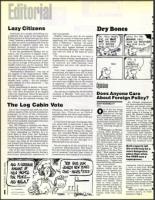
YOU 1-14VE
dEtA/0-1 NEW/Mt
CAKE - 1?Ecift 4 5753"
1:4
FOR nftam
Ao\toil.A!
Editor
One can laugh at all this and chalk it up
to political self-preservation. But doesn't
this also imply that Americans believe this
sort of nonsense? And isn't that a form of
condescension that smacks of true elitism?
1,43)
2°
0
...
3
--1
F-
O
6
0
Does Anyone Care
About Foreign Policy?
GARY ROSENBLATT
Oklahoma, where Mr. Bush attempted to
portray Gov. Clinton as an Oxford-
educated elitist and social experimenter —
and himself, of course, as a man of the peo-
ple.
It was beyond the pale of campaign rhet-
oric, given that it came from a man who
grew up in wealth in Greenwich, Conn.,
(his father was a U.S. senator), who was
chauffeured to school during the Depres-
sion, who attended Philips Academy and
Yale University, who has a summer home
on the Maine coast, and who got his start in
the oil business on the strength of a
$300,000 gift from his family.
I/
NEW NoPEZ
AL OUR Si NS !
Until voter registration is significantly
streamlined, the right to vote will, at least,
be perceived to be compromised. And even
though Jews may pride themselves on
their relatively high rate of registration,
not until every eligible Jew in the country
is registered — and regularly votes — can
Jewish leaders say that their community is
exercising its full political power and voice.
The Log Cabin Vote
Let us for a moment put aside the more
sublime aspects of the current presidential
campaign in favor of the ridiculous.
Granted, that's easy given the red-meat
style of contemporary presidential politics
that all but excludes meaningful discourse
and favors image over reality.
Gov. Bill Clinton is certainly not above
redefining himself to garner votes. Just
listen to how his Southern accent thickens
or thins, depending on whether he's in
Little Rock or New York. But President
George Bush is in a class by himself on this
one. One wonders if Mr. Bush has not put
so many new faces on his administration
and himself that Barbara has been left to
wonder who this guy is who keeps leaving
his shaving cream in her bathroom.
One of the more ludicrous of the presi-
dent's reality spins came recently during a
down-home presidential appearance in
rt.A.4(1.,6 oN - THe
JEuilSA NEW
CeEAR WE REY16MeeR
•
Cyr/ 'a/
41
O
ne of the few things
that Democratic and
Republican foreign
policy advisers agree on in
this presidential campaign
is that, with all the focus on
the economy and jobs here at
home, international issues
are not receiving enough at-
tention.
In Washington on Monday
evening, Peter Rodman, a
senior foreign policy adviser
for the Bush-Quayle ticket,
and Madeleine Albright,
who holds the same post for
the Clinton-Gore slate, ad-
dressed a symposium spon-
sored by the American Jew-
ish Congress on "The For-
eign Policy of the Next Pres-
ident." Each speaker began
by decrying the fact that, as
Ms. Albright noted, "no one
seems to want to hear about
foreign policy." (Indeed, only
about half of the 150 seats in
the room were filled.)
Ms. Albright and Mr.
Rodman talked about the
importance of America hav-
ing a strong, focused ap-
proach to the rest of the
world. From there on, they
parted ways, though it was a
quite civil debate. There
were no voices raised, no
tables pounded, and both ex-
perts, who noted that they
have squared off before in
such forums and remain
friends, made their cases
well.
Ms. Albright emphasized
the interconnection between
domestic and foreign policy
and said that Americ
cannot be strong in the
world unless it is strong at
home. Mr. Rodman credited
Mr. Bush for a number of
international diplomatic
successes during the last
four years, including the
Mideast peace negotiations,
and said the president has
the credibility and track
record to inspire confidence.
Curiously, both experts
felt the world may very well
be a more dangerous place
today than it was when the
USSR was America's rival
Both experts felt
the world may be a
more dangerous
place than when
the USSR was a
superpower.
superpower. And it's not just
a case of post-Cold War
blues, they said, pointing to
the rise in Islamic fun-
damentalism, the number of
"outlaw" states whose dic-
tators are working toward
building nuclear arsenals
and the chaotic results of the
breakup of the Soviet Union,
particularly in Eastern
Europe.
When the USSR was our
military equal, at least
Continued on Page 8