
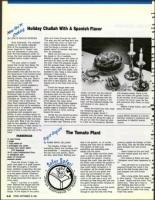

Yett. (i ricm Holiday Challah With A Spanish Flavor
Ce t‘
By LESLYE MICHLIN BORDEN
Rosh Hashanah. The sweetest
holiday on the Jewish calendar.
Both at the synagogue and at
home, hopes for a "sweet" new
year are expressed in every way.
Even the food traditions center on
honey, the most common sweetener
available before modern refined
sugar.
This year, select a challah
recipe that comes from Spain. By
doing so, you will underline the
spirit of forgiveness and
reconciliation that sets the tone for
this observance. Five hundred years
ago, Spain expelled the Jews, its
leading citizens. This year, Spain's
current king, Juan Carlos, atoned
for this act and invited the
descendants of those expelled to
return to their "homeland."
In this sense, selecting a few
Spanish recipes for your Rosh
Hashanah feast is particularly
appropriate. Pandericas, which
translates as "bread of the rich" or
"rich bread," fits in with all the
other Rosh Hashanah themes. The
recipe uses honey as its sweetener,
and a lot of it. In addition, sprinkling
the top with sesame seeds
symbolizes both prosperity and
fertility. A more mundane reason to
prepare this bread recipe is that the
dough is wonderfully light and easy
to work with. Best of all, the recipe
calls for four packets of yeast so it
rises very quickly. It takes almost no
time to prepare. This gives you
plenty of time to cook the rest of the
meal.
PANDERICAS
3/4 cup honey
3 eggs
1 cup salad oil
4 packages dry yeast
4 cups very warm water
(115 degrees)
10-12 cups unbleached flour
1 /2 teaspoon salt
dash of cinnamon
sesame seeds
Place the honey, 2 eggs, oil,
yeast, and water in a large ceramic
bowl. Mix thoroughly. In another
bowl, combine 5 cups flour, the salt,
and cinnamon. Gradually beat this
in to the yeast mixture. Continue
adding flour, 1 cup at a time, until
the dough becomes thick (about 4-5
more cups).
Place 1 cup flour on a pastry
cloth. Remove the dough from the
bowl and place it on the floured
cloth. To aid kneading the sticky
dough, lift the edges of the pastry
L-6
FRIDAY, SEPTEMBER 18, 1992
cloth and knead through the cloth.
This way, you will use less flour and
your bread will come out light and
have a wonderful texture. Knead
until the dough is smooth and
elastic, about 10 minutes. Add more
flour as necessary.
Wash out the bowl you mixed
the dough in. Dry it carefully.
Moisten a paper towel with salad oil
and use it to wipe out the inside of
the bowl. Place the prepared dough
into the greased bowl. Cover with a
damp, clean towel and let it rise in
a warm place, free from drafts, until
doubled in size. Keep a close watch
because it rises quickly.
Wipe the inside of 2 9-inch
cake pans with vegetable oil. Heat
the oven to 350 degrees. Set your
baking rack to the lower third of the
oven.
Punch the dough down and
turn it out onto your pastry cloth.
Divide it into two equal parts. Put
one piece back into the bowl and
cover it while you work on the other
half. Divide this piece into 4. Roll 3
of the pieces into ropes about
16-inches long. Braid them together
and seal the ends. Starting at the
outside edge of prepared cake pan,
coil the braid in a circle, working
toward the center.
Divide the one remaining piece
into 3 parts. Roll each into a rope
about 12-inches long. Braid these
into a smaller rope. Starting at the
sek5 ct
soel
with sesame seeds. Place in the
oven and bake until golden brown,
30-40 minutes. (If the breads start
to brown too much, cover the top
with aluminum foil). Place on racks
to cool.
Makes 2 large loaves, each with
about 25 slices.
Leslye Michlin Borden is a former
Detroiter residing in California who
specializes in healthful kosher
cuisine.
The Tomato Plant
By RABBI MARC GELLMAN
The Garden of Eden had
everything. Bears and monkeys, fish
and butterflies — everything. Even
the first man and woman, Adam
and Eve, were there. Nothing ever
take S9
center, coil them into the topknot,
tucking in the ends. Set aside to
rise. Repeat the process with the
other half of dough waiting in the
bowl. Let the prepared breads rise
until double in size, about 30
minutes.
When the bread has risen, beat
the remaining egg with a
tablespoon of water. Brush it
carefully onto the bread, taking care
not to let any fall along the sides of
the pan (or else the bread will stick
to it and not rise properly.) Sprinkle
IQ/ Y
died in the garden, so, of course,
nothing was ever born to replace it.
The Garden of Eden had
everything, but everything was
always just the same.
One day Adam and Eve came
upon a crack in the big wall that
surrounded the garden. Looking
through the crack, they saw that in
the brown dust outside the garden a
tomato plant was growing. At first
they could hardly recognize it. In
the garden, all the tomato plants
were tall and full and green with
many big red tomatoes on each
stem. What they saw through the
crack in the wall was a puny and
shriveled up little thing with just one
tiny green tomato barely hanging on
to one of the stems.
Every day Adam and Eve would
come to the crack and peep
through to see how the only thing
growing outside the Garden of Eden
was doing. One day the little tomato
plant drooped over and turned
brown.
Adam looked at Eve and said,
"It never looked good, but now it
looks worse."
Eve looked at Adam and said,
"Whatever could have happened to
it?"
They sat there for a long time,
peeping through the crack in the
wall at the little tomato plant that
had drooped over and turned
brown.
After a long while, God spoke
to them saying, "The tomato plant
is dead." Adam and Eve cried. They
asked God, "Why did it have to
die? Nothing dies here in the
garden." But God would not answer
this question no matter how many
times they asked.