

CLOSE-UP
Shoshana Cardin
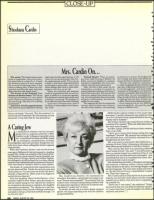
Mrs. Cardin n On...
The press: "The Israeli press is more
prone to imagination, fancy and creativ-
ity when there is no basis for it. I. found
the American press to be more responsi-
ble, in terms of reporting closer to that
which is taking place. If there are prob
lems that come from the press, they more
often come from the Israeli press."
The future of the National Con-
ference on Soviet Jewry: "We left our
recent board meeting in a very upbeat
mood. There is a new sense of invigora-
tion and energy. The story of our demise
is premature.
American Jewish organizations:
`The recent economic difficulties will help
restructure Jewish organizations. It will
reduce the fat and streamline (the Jew-
ish organizational world). There may be
a desire to help those organizations that
are strongest in some areas - and to have
others change their focus or limit them-
selvi:z to what they can do well.
"There are emotional and personal
needs for organizations that we can't ne-
glect, in addition to communal agendas.
The experience has been that people need
to belong to something. The question is,
do we take seriously that need to belong?
"Jews have to become more a part of
the fabric of what makes a local commu-
nity work."
Yitzhak ShEuriir: "First, we need to
give him credit for going to Madrid, He
did go, and he put together an outstand-
ing team of negotiators who were com-
mitted, educated and sophisticate&
"Also, the fact is that under his ad-
ministration a number of countries re
sumed diplomatic relations with Israel. I
think that's important. The economy has
improved, despite what people are say-
ing, and is doing better than most people
recognize. Unfortunately, that does not
make the front pages.
`The rliTatives are that the settlements
activity, which he knew was a thorn in
the side of the president, was something
that as chutzpah," she said. "But the reaction I re-
ceived was one of attention. He was listening, he was
concerned. It was clear that he was opening up."
A Caring Jew
M
r. Gorbachev's response was not unusual;
people tend to respond positively to Mrs.
Cardin's words. Colleagues repeatedly praise
her - even behind her back and off the record
- as intelligent, compassionate, Jewishly
knowledgeable, calm and articulate, though they con-
sider her a loner whose unflappable exterior appears
impenetrable.
When her husband, Jerome, was on trial several
years ago in Baltimore for his involvement in a banking
scandal, Mrs. Cardin was president of the Council ofJew-
ish Federations, whose annual General Assembly was
taking place in Chicago. Quietly and without fanfare,
she managed to shuttle between the two cities, offering
support to her husband through her presence in the court-
room, then flying to Chicago to deliver a major address.
One leader of a national Jewish organization says
he has observed Mrs. Cardin for several years and
"she's always on. I've never seen her let her hair down,"
literally or figuratively. "She's a bit of an enigma to
me but she is a class act."
Even her daughter, Nina Cardin Reisner, a Con-
servative rabbi in New Jersey, says she cannot re-
call her mother losing her cool. Asked if her mother is
as composed as she seems to outsiders, her daughter
responded immediately: "Yes. Maybe for a split sec-
ond, sometimes, there may be a fleeting moment you
can catch in her eye, if you look carefully enough. 2 , it
no, it's very rare."
28
FRIDAY,_ AUGUST 28, 1992
Mrs. Cardin's son, Sanford, who represents the
Jerusalem Foundation, agreed that his mother is al-
ways "focused and purposeful." He surmised that his
mother's early training studying acting combined with
her diplomatic experience, allows her to hide her feel-
ings behind "a poker face" at times.
In private, he said, she is a warm, family oriented
person who enjoys spending time with her children
and grandchildren.
he chose not to control. His budgets did
show a larger sum spent in the territories,
money that did not necessarily create jobs.
"He was very candid in a discussion
in which I suggested that the direction be-
ing taken [regarding settlements] would
be viewed negatively, and would create
enticism [in Washington]. He said that
we have to remember that if you're not in
political office, you can't accomplish any
thing In order for him to accomplish what
he believed had to be done, he had to be
in office. That was his political philosophy
- which happens to be not very different
from George Bush, who says the same
thing in a different way."
Rabbi Cardin said her mother is "very much what
she seems," a product of parents who taught her that
"as a Jew, she had certain responsibilities to the com-
munity and to Judaism."
Her brother, Sanford, also noted that his mother is ,
a product of her parents. 'When she talks about them,
her whole tenor changes."
For Mrs. Cardin, Jewish activism is less a vocation
than a way of life.
"I grew up in a home where being a caring Jew was,
important," she said. "My parents were caring Jews,
and informed Jews, and Jewishly educated Jews. I
thought that all Jews were."
She was raised in pluralistic East Baltimore, a
melange of Jews, Poles, Lithuanians, Germans and
other ethnic groups looking for a toehold in America.
"But I always felt there was something different --
about being Jewish," she said. "I was fortunate in,
that my parents helped me understand that it was -1
something rich and beautiful and meaningful - and
something that had to be translated into action. Sim-
ply being Jewish wasn't enough."
She recalled that her father, a European immigrant_ j
and melamed, or Hebrew teacher, was an inveterate
writer of letters to the editor, even though English was?
his third language. "He wrote about justice and moral-
ity. He felt that Jews have a responsibility to speak
out. That's how I grew up."
Mrs. Cardin said that what drives her is not a sense
that she can do better than others, but the notion,- I
instilled by her father, that Jews have a responsibil- ,_
ity to speak out.
"That's how I was raised," she explained. "People
have known that I am not afraid of authority and pow-
er. I never have been. I was not taught to be afraid of
authority and power."
❑