

SPORTS
I
Torah At The Races
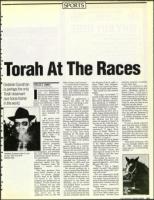
• Gedaliah Goodman
is perhaps the only
0 Torah observant
race horse trainer
in the world.
OP
•
los
•
Gedaliah Goodman rises at 3 a.m.
► to pray. Then he's off to
Belmont Park.
p
•
►
HARLAN C. ABBEY
Special to The Jewish News
I
n the Crown Heights sec-
tion of Brooklyn,
Gedaliah Goodman looks
like all the other Chasi-
dic Jewish men: conser-
vative clothing, untrimmed
beard and sideburns, a dark
fedora or yarmulke on his
head and the tzitzit
from his tallis katan
can sometimes be
seen beneath his
shirt.
He arises each
day at 3 a.m. to go
through the Luba-
vitch study and
prayer ritual, final-
ly putting on his
tallis when it's
light. Then he goes
off to work — at
Belmont Park.
Gedaliah Good-
man is a race horse
trainer, probably
the - only Torah
observant Jew in
the world with such
an occupation, and probably
the only Chasid engaged in
professional sports as an ac-
tive participant.
At Belmont, where he has a
one-horse stable (I'm Ma-
jestic), Goodman looks dif-
ferent — much, much
different.
"The peer pressure from
other horse owners is too
great," he admits. "Jewish
owners want to be WASPs.
I've heard it all: 'You're
religious, you people have no
freedom: `I'd love to have you
as a trainer, but my wife
couldn't handle it 'You don't
understand, I'm only the
third Jew at our country club.'
`You won't eat in the
clubhouse with us and the
other owners and trainers.'
"I've had lots of winners on
Saturdays, and once I even
went to the track on the Sab-
bath — but I didn't saddle the
horse. The training is done
before the day the horse races,
anyways.
"With my appearance, I
become the story, not the
horse. Am I watching a com-
edy or a horror show?"
It's not that Goodman
hasn't proven his skill. While
spending a couple of seasons
in California he bought San-
tangelo in Argentina and
that horse was good enough
to finish fourth to Sunday
Silence and Criminal Type in
the $1-million Hollywood
Gold Cup in 1990 and place
third in a $500,000 race.
"Other trainers have 30-40
horses to train, have been
training for 20 years and
never had a horse good
enough to start in a $500,000
race, let alone a $1 million
race," he says.
Actually, Goodman is in his
second career as a trainer.
Born in South Bend, Ind., he
moved with his family to the
Miami area as a youngster.
He was a U.S. Army crypto-
grapher with top secret clear-
ance, played semi-pro football,
attended the University of
Miami for a while and was
visiting Cuba when the
revolution broke out in 1959.
He started working for a
trainer named Ben Rosenthal
and saddled his first winner
at River Downs in Ohio in
1963 or 1964. From then on it
was winters in Florida and
summers in the East and
Midwest; one of his clients
was Flagler Farm, co-owned
by Meyer Lansky.
It was, he now admits, life
in the fast lane with big cars,
the race track during the day,
jai-alai and poker games and
the Playboy Club at night, a
closet filled with designer
clothes and matching shoes,
and lots of gold neck chains.
But inside, his life seemed
empty.
"One night," he recalled, "I
turned on the radio and heard
the Lubavitcher Rebbe,
Menachem Mendel Schneer-
son, speaking in Yiddish. I
didn't understand a word, but
something about it was very
comfortable, very moving!'
He and his son Tzvi, now a
rabbi, began taking classes at
the local Chabad Lubavitch
yeshiva. And soon he gave up
his lifestyle and his wife,
when he moved to Israel at
the age of 38, with his son.
"I got by with a stipend and
some money from home," he
continued. "I spent three
years in Kollel Yeshiva in
Jerusalem, three years at
Kfar Chabad and three years
in Safad. I loved it?'
He would still be in Israel,
with his second wife, Miriam,
if his father hadn't been
stricken with a fatal illness in
1984. He returned to the U.S.
and couldn't resist the
challenge of trying to fit his
new lifestyle into the race-
track's backstretch.
But before he started, he
wrote Rabbi Schneerson, who
gave his approval — providing
Miriam did, also.
"When I had a bigger
stable," he said, "she enjoyed
walking the horses after exer-
cise and races!'
His new appearance made
him a race track oddity, but it
was easier being accepted by
most of the other trainers and
backstretch workers than by
horse owners, especially
Jewish ones.
"They would come up to me
and tell me, in Yiddish, 'Get
out of here, We'll support you.
Just go away, " he said. Once,
someone painted a swastika
on his barn door.
When he returned to the
U.S. and decided to train once
again, Goodman called a
former client: "I told him I
had picked out a horse that I
could improve. He told me to
come to his office and pick up
his check for $45,000. When
I did, he took one look at me
and tore up the check.
"That horse went on to win
about $275,000, and he blam-
ed me! Every time the horse
won, he told me 'Because of
you I didn't buy that horse! "
A similar situation caused
him to leave California for
Brooklyn:
"I went to South America
and I saw this mare in Argen-
tina I liked. They wanted
$300,000 for her, but I think
we could have bought her for
$250,000. But the men I ap-
proached didn't have enough
confidence in me to put up the
money.
"That mare is Paseana, who
won six straight stakes, was
the 1991 champion older
mare and now is worth $3-$4
million!"
❑
!II
• L