

RELIGION
PEERING
INTO
THE LIMBO
OF
VIP
.
4
The hyphen
implies
that the
two religions
are twins,
but they
are very
different.
HAROLD M. SCHULWEIS
Special to The Jewish News
0
n the wake of Pope John
Paul II's 1987 visit to
America, a revival of
Christian-Jewish anecdotes
took place: One such story
tells of Cohen's conversion to
Catholicism, for reasons un-
known. The Knights of
Columbus hosted a banquet
in Cohen's honor. Called
upon to speak, Cohen looked
at his audience, devoted lay
Catholics, priests, bishops,
monsignors, and began his
address: "Fellow Goyim."
That genre of Jewish humor
is meant to console. It in-
sinuates that the conversion
has not taken and that an in-
eradicable residual identity
remains: a Jew remains a
Jew, even after conversion.
The challenge to Jewish
identity comes less from
outright conversion than from
surreptitious deconversion.
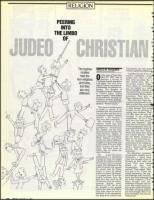
The hyphen, not the cross,
dissolves Jewish identity. The
Judeo-Christian hyphen is
turned into a sign of identity.
While Judaism and Chris-
tianity may appear different,
stripped of externalities they
are the same. Blue and white
lights or green and red fix-
tures, hot-cross buns or
latkes, they all signal the
same directions.
The
Judeo-Christian
hyphenation is a theological
triumph for those who sought
to break the hyphen and free
Christianity from its Jewish
origins. The defenders of the
Judeo-Christian link warned
the church that for Chris-
tianity to sever its Jewish
bonds is to attach Christiani-
ty to pagan roots. To cut the
grafted branches from the
good olive tree could cut off
Christianity from its authen-
ticating Jewish roots.
(Romans 11:17F). Yet for all
the benefits in the grafted
hyphen for Jews and Chris-
tians alike, there are serious
liabilities in the assumption
that deep down Judaism and
19
__ERIDAYALIALLQTALACIO9
Christianity are twin faiths
without significant difference,
Consider the case of two at-
tractive, intelligent, young °-)
people, very much in love,
who enter my study. He, a
Jew named Sam. She, a <
Christian named Peggy.
Their object is matrimony,'
and the subject is a rabbi
liberal enough to officiate at
the mixed union or alongside
a liberal priest. Neither seeks
conversion. They seek an
Equal Opportunity Cleric.
They each have vague sen-
timental attachments to the
faith in which they were rais_---)
ed and genuine filial fidelities `)
to their parents. They have
thought out the dilemma of
raising their children. They
will offer them the dual ad- )_)
vantages of two religious `--)
civilizations. "If it's a boy,
we'll have him both circum-
cised and baptized," they c=.
agree. Far from seeing conflict
in the arrangement, they are
convinced that the wisdom of
both Old and New Testa- <
ments will enrich their lives 0
and confirm Malachi: "Has
not one Father created us.
Hast not one God made us."
They see vindication in the
similarities of the traditions.
Toward their own and each
other's religious belief and
practice they offer benign
neutrality.
The discussion wandered.
At one point, possibly out of
frustration, I asked them
what they thought of my of-
ficiating as both rabbi and
priest. They were taken
aback at this bold
ecumenicism. "You're not '-
serious?" They asked. "Well
let's play it out. I know the
church sacrament, the nup-
tial blessings, and I certainly
know the seven blessings of
the Judaic tradition," I said.
Peggy thought such syn-
chronistic virtuosity a bit too
much. She couldn't quite con-
jure up the union of surplice
and tallit, swinging rosaries
and tallit fringes. Still if we
have one Father, why not one
rabbi-priest?