

IN NEW HANDS
Ho nan, who has taught at HUC
in New York for 18 years. "When
women first came, we thought
we'd just do what we always did,
but do it with women in the room.
But with women, came the femi-
nist critique...Now we've gotten to
where we're thinking about things
so differently."
Prof. Hoffman is involved in the
creation of a new Reform prayer-
book that will be not only gender
neutral with regard to people, but
will also try to foster gender-in-
clusive images of God and make
reference to the foremothers as
well as the forefathers of Judaism.
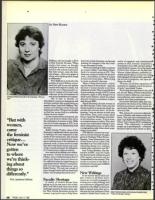
Orthodox feminist and author Blu Greenberg: "Wh y not
me?"
"All of this is directly at-
tributable to women in classrooms and
old-time teachers like myself being ex-
posed to them," says Prof. Hoffman. "Ed-
ucation now becomes more than just
statements of fact. Women have taught
us that how we see truth is a reflection
of how we were raised."
In the Conservative movement, the
bitter and divisive debate that led to
the ordination of women in the 1980s
also led to broad changes at JTS, in its
curriculum and in its relationship with
the laity. •
Rabbi Gordon Tucker, dean of the
Seminary's rabbinical school, says that
in seeking to be more responsive to the
needs of the community, the school's
curriculum was revamped four years
ago to include more of an emphasis on
pastoral work, to focus more on texts
that deal with family issues and to de-
velop in small seminars the definition
of a Conservative religious identity.
As a result of the debate over ordain-
ing women, "I think the Seminary is a
fresher, more revitalized place than it
used to be; there's more of a focus on
the rabbinical school no longer being just
a graduate school. There's a realization
that we're serving a constituency," says
Rabbi Tucker. "It's not just a study of
texts, [though] that's still our bread and
butter. God is being discussed more."
"But with
women,
came
the feminist
critique...
Now we've
gotten
to where
we're think-
ing about
things so
differently."
-Prof. Lawrence Hoffman
Faculty Shortage
A variety of student groups have
sprung up in the past year or two at both
HUC and JTS to deal with some of the
challenges posed by having women rab-
bis. They include discussion groups for
women, a group for men to help them
28
FRIDAY, JULY 17, 1992
deal with Jewish feminism, and groups
pushing for changes in the way wom-
en are discussed in class.
"We're just starting to define ourselves
as women rabbis," says Karen Reiss,
head of a women's group at JTS. "Stu-
dents are trying to create the ground-
work, a foundation, so there is a place
to turn to for every issue...We're trying
to create a network," she says.
Many of those interviewed — includ-
ing the deans of the schools — bemoan
the lack of women faculty at all three
rabbinical schools. There is one full-time
female professor at each of HUC's three
campuses; eight at JTS, though five of
those teach Hebrew, which the school
does not consider an academic subject;
and three at RRC.
Sherri Blumberg, the lone woman on
the HUC faculty in New York, says her
female students in particular dearly ap-
preciate her presence there. "At the be-
ginning, I was an advisor to both men
and women. Then, more women asked
for me," says Prof. Blumberg, who teach-
es the education course. "A lot of wom-
en wanted someone to talk to. They don't
always feel comfortable talking to men
about relationship issues, or about when
a congregation asks them about preg-
nancy or sexuality."
JTS offered a course last sum-
mer on Jewish feminist thought,
given by Professor Tikva Frimer-
Kensky. Yosef Abramowitz, one
of only three men in a class of 28,
describes it as "one of the most in-
vigorating classes ever. Judaism
is stale today and here I saw life."
Prof. Frimer-Kensky, who also
teaches at RRC, says she hopes
this kind of course will become part
of the regular curriculum and not
"marginalized in the summer." Her
course on women in the Bible is
scheduled to become part of RRC's
curriculum next fall.
•
New Writings
rector of research and institutional
grants at JTS, recently completed a
translation of an 18th century Italian
prayerbook for women. Out of the Depths -
I Call to You: Prayers for the Married
Woman (Jason Arenson, publisher) in-
cludes prayers that a woman can recite
before going to the ritiial bath, upon find-
ing out she is pregnant, and upon de-
livery of a child.
"Women, out of their experience of
exclusion in Judaism, know the power
of texts," says Rabbi Tucker.
They bring this experience to the pul- -.-
pit, as well. Many of those interviewed
point to today's rabbis as a new breed —
more informal, more indusive, more ac-
cessible than their predecessors.
It is a more "feminine" rabbi, they say,
shaped by the forces of the 1960s, the
feminist movement, and the search for
spirituality that marks contemporary_
American life.
"The nature of a woman's rabbinate
is one of facility and access to the tra-
dition. This has had a tremendous im-
pact," says Rabbi Norman Cohen, dean
of New York Campus HUC's rabbinical
school. "The community is getting
caught up in participation — everyone
should be able to learn Torah on their
In the schools and in their pul-
pits, women in all three move-
ments are currently engaged in
writing new works of liturgy and
new midrashim (allegorical inter-
pretations of the Bible) to shed new
light on ancient texts; other are re-
daiming the lost traditions of their Sally Finestone director of the Harvard-Radcliffe Hillel:
mothers. Rabbi Nina Cardin, di- 'There are still glass ceilings."