
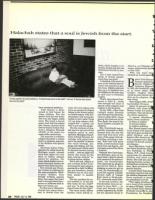

Halachah states that a soul is Jewish from the start.
The key question for social workers is, "Is this the best home for the child?" and not, "Is this the best Jewish
home for the child?"
have emotional problems.
Vicki Krausz is deter-
mined to find homes for
these children. But she
doesn't want just any home.
Not even any happy, stable
home. She wants a Jewish
home. And that has placed
Mrs. Krausz, director of the
Denver-based Jewish Chil-
dren's Adoption Network
(JCAN), at the center of a
nationwide controversy.
The question is whether
religion should be a critical
factor in adoption, especial-
ly for children with special
needs.
American Indian tribes,
because of a ruling issued by
Michigan courts, already
have first rights over any
child of Indian descent
placed for adoption. For
years, black leaders have in-
sisted that black children be
placed with black families.
Now Jewish and Christ-
ian workers are fighting for
the same guarantee. Hard-
to-place children have
enough working against
them, they argue; they don't
need to accommodate them-
selves to a different faith in
their new homes, too.
Furthermore, Halachah
(Jewish law) states that a
soul is Jewish from the
24
FRIDAY, JULY 10, 1992
start. So even infants who
have no concept of religion
belong to the Jewish people,
in Jewish homes, with Jew-
ish parents. One is even per-
mitted to sell a sefer Torah
if it can help redeem a kid-
napped Jew — namely, one
who is not with his people.
But the existence of Jew-
ish souls is not part of the
adoption policy at state
agencies. Michigan Depart-
ment of Social Services, for
example, tells social work-
ers to "be mindful" of factors
like racial heritage, lan-
guage and religion, and "ini-
tial placement efforts shall
be directed toward placing
a child ... with an approved
family that meets all the
best interest criteria" in-
cluding similar religion.
But in the end, religion is
not a critical factor in de-
termining the best adoptive
parents for a child. In Michi-
gan and elsewhere, Jewish
children can be and have
been placed in gentile
homes.
The key question for so-
cial workers is, "Is this the
best home for the child?"
and not, "Is this the best
Jewish home for the child?"
The issue rarely affects
healthy, white Jewish in-
fants, whose number is ex-
tremely limited and who can
find homes literally in min-
utes.
But it does impact hun-
dreds of Jewish special-
needs boys and girls.
A disabled child born last
year in the Detroit area re-
cently was placed in a gen-
tile home. Rabbis estimate
that up to 10 disabled Jew-
ish children in the state may
go each year to Christian
couples.
That's what almost hap-
pened to Nelli K., whose
case brought the issue of
special needs adoption and
religion to the forefront.
In July 1991, a New York
Catholic couple, Kenneth
and Theresa Orzechowski,
tried to adopt Nelli, whose
picture they had seen in the
Blue Book, the state's list-
ing of children available for
adoption.
Mrs. Orzechowski was es-
pecially interested in Nelli
because both she and the
child had been born with
some of the same birth de-
formities, including a club-
foot. Nelli also had spina
bifida, a heart murmur and
fused toes and fingers, and
had spent much of her life in
a hospital.
Because New York State,
like Michigan, does not de-
mand that a child be placed
with parents of the same re-
ligion, the Orzechowskis
were approved as adoptive
parents for Nelli K. After
pledging to raise the girl as
a Jew, the Orzechowskis se-
cured the support of Rabbi
Hirshel Jaffe of Temple
Beth Jacob in Newburgh,
N.Y., where the couple lives.
In the end, however, the
Orzechowskis were not al-
lowed to have Nelli -- in
large part because of the
protest registered by JCAN
and the Agudath Israel of
,_1
America, an Orthodox ad-
vocacy organization based
in New York.
Nelli has since been
adopted by Jewish parenti
B
efore Vicki Krausz
formally opened the
Jewish Children's
Adoption Network
in 1990, she handled 27 cat-
es in three years. She
couldn't imagine there
would be more Jewish chil-
dren up for adoption. She
was wrong.
Since August 1991, JCAN
has handled 150 cases.
About 15 percent of 07--
children with whom Mr:, ,
Krausz works are healthy
newborns. The rest fall into
one of four categories:
1) mental retardation;
mostly Down syndrome
2) abuse or neglect
3) biracial infants
4) medical problems
Mrs. Krausz doesn't want
to lay blame with families
who opt to give up their dis-
abled children, and she
doesn't offer theories as t
why it appears such a large
number of Jewish parents
are doing so.
Janet Marchese, head of
the Down Syndrome Adop-
tion Exchange in Whit
Plains, N.Y., finds homes
nationwide for adoptable
children with Down syn-
drome. She said she sees a
disproportionate number of
Jewish Down syndrome chil-
dren. Most are placed with
gentile families.
A recent Israel Television
broadcast reported that half
the children diagnosed with
Down syndrome in Israel
are abandoned at birth. ,
"This tragic situation is
not a result of the inability 1
to raise a DS baby," accord-
ing to Chaim Plato, director
of Israel's Count Me In, the
Foundation for Disabled
,