

FOCUS
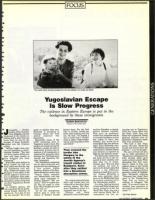
The Ledich family recently escaped the civil war between the Croats and Serbs.
Yugoslavian Escape
Is Slow Progress
The violence in Eastern Europe is put in the
background by these immigrants.
SHARON MARCOVITCH
Special to The Jewish News
erusalem — Gordon
Ledich, of the Croatian
town of Zagreb, was less
frightened of the bombs ex-
ploding half a mile from his
house than he was by the
thought of being forcefully
0 enlisted into the Croatian
militia.
"Militia toughs were cora-
ing and knocking on doors,"
explains Gordon. "You had
one of two choices. Either you
went with them quietly or
they dragged you away
screaming!'
With these grim options in
Mind, Ledich, his wife and
their infant son fled the rag-
ing Yugoslavian civil war.
They crossed the border into
Hungary to the safety of the
Jewish Agency's transit sta-
tion in Budapest. Soon after,
they settled into a Beersheva
absorption center along with
six other Yugoslavian Jewish
families.
In Gordon's opinion, the
war is pointless for the poorly-
armed Croats. However, he
points out, "As a Jew, it's not
my war anyway." He is also
quick to explain that anti-
Semitism is mounting in
Croatia, where the local
Jewish cemetery was
desecrated.
Reportedly, many of the
5,500 remaining Jews in
Yugoslavia want to leave. But
borders are closed and only 60
families a month are able to
reach Israel. In Israel, the ab-
sorption of all immigrants is
supported by American Jews
through the UJA/Federation
Annual and Operation Ex-
odus Campaigns.
The Yugoslavian emigrants
who do reach Israel are well
prepared for the challenges of
a new culture. Judith
Galperin, director of the Beer-
sheva absorption center, says,
"They're highly educated,
very Westernized, and they
speak many languages in-
cluding English:' She con-
tinues, "They're capable peo-
ple who are eager to work
hard. We're delighted to have
them with us."
As for the immigrants,
they're glad to leave the
misery of Eastern Europe
behind them. For the first
time in months, Ledich can
relax when playing with his
son. He says, "In Zagreb, I
was so tense that I couldn't
sleep at night. I kept imagin-
ing my son being taken away
and killed!'
They crossed the
border into
Hungary to the
safety of the
Jewish Agency's
transit station in
Budapest. Soon
after they settled
into a Beersheva
absorption center.
The violent strains between
Serbs and Croats have not
rubbed off on Jews from these
warring regions. The Beer-
sheva absorption center is a
congenial mix of the two.
Zlata
and
Dushan
Michaelik, both middle-aged,
are from Vojvodina, a cosmop-
politan Serbian republic.
They gave up prominent
careers as a journalist and as
a university professor so that
the oldest of their four
children, Jan, would not be
conscripted into the Serbian
army. Zlata Michaelik says,
"The Serbian nationalists are
interested in a Greater Serbia
and everyone is expected to
fight for the Serbian cause."
The Michaeliks realize that
the army service is also ex-
pected of their children now
that they are in Israel.
Dushan says, "It's true that
our children will have to
serve in the Israeli army. But
there's a big difference
because at least this is our ar-
my." Dushan Michaelik is
also more optimistic about
peace in the Middle East than
he is about a peaceful end to
the Yugoslavian conflict.
For many, fighting between
Croats and Serbs brings back
bloody memories of the last
World War. Zlata, who was a
child during World War II,
remembers the last na-
tionalist war in Yugoslavia,
when the Croats sided with
the Nazis. Both Jews and
Serbs were massacred. Zlata's
paternal relatives were all
deported to Auschwitz, where
they were annihilated.
"We built a new Yugo-
slavia," she says. "Serbs and
Croats had buried their dif-
ferences — or so we thought!'
The new arrivals are join-
ing an older generation of
Yugoslavian immigrants who
have already made their
mark on Israeli society. While
discussing this first wave,
they're asked if they con-
sidered going to the United
States or elsewhere in
Europe. The question elicits a
generous round of laughter.
Zlata Michaelik responds,
"Everyone has closed their
doors to the Yugoslavians.
They fear an influx of
millions of refugees." She
adds, "If we weren't Jews, we
wouldn't have anywhere in
the world to go. So we've come
home."
❑
UJA Press Service
RI