

BACKGROUND
Syria And Israel:
Flirting With The Brink
In South Lebanon, one unexpected development
could turn limited fighting into a regional war.
r
DOUGLAS DAVIS
T
Foreign Correspondent
°he Middle East peace
process experienced
its sternest test last
• week as Israeli and Syrian
leaders glared at each other
across the armistice line and
their proxies slugged it out
—) in Lebanon.
The name of this highly
dangerous game is
"controlled brinkmanship,"
) with the Syrian-backed Hez-
bollah fundamentalists
taunting the Israeli-backed
- South Lebanese Army in a
series of surprise attacks
that at times threatened to
breach Israel's highly sen-
sitive northern border.
Israeli jet fighters scream-
ed back over the skies of
Lebanon to strike at key
military bases of the Hez-
bollah fundamentalist
movement, some in southern
) Lebanon, others only a few
miles from the Syrian
) border.
1
Three times the Syrians
unleashed anti-aircraft mis-
siles, three times they miss-
ed. And three times the pro-
spect of war was narrowly
averted.
In a rare television inter-
view, Syrian President
Hafez Assad, told the BBC
that while he was not look-
• ing for a fight, he was ready
to defend against an Israeli
attack.
As the situation de-
E.)
teriorated, Egyptian Presi-
dent Hosni Mubarak raced
to Damascus with Foreign
o Minister Amr Mousa and
senior advisor Osama al-Baz
to deliver the ritualistic
assurance of Arab solidarity.
The subtext of his mes-
sage, however, was delivered
I in the names of Egypt, Saudi
Arabia and the United
States — a plea for restraint
and not to allow the
brushfire in Lebanon to rage
out of control, engulf the re-
gion and devour the peace
process.
Yet the key to calming the
passions of Lebanon's Shi'ite
fanatics lay further
eastward. While Syria
° serves as a vital conduit for
arms and other essential
supplies, real power resides
in Teheran, which provides
the cash, some 1,000 Iranian
Revolutionary Guards to
train the Lebanese funda-
mentalists and, most impor-
tant, the spiritual
sustenance for Hezbollah.
Regional leaders held their
collective breath last week
as Iran's urbane foreign
minister, Ali Akbar
Velayati, arrived in Leb-
anon, only to exhale in dis-
appointment when the au-
thoritative Beirut daily as-
Safir announced that he
had rejected a request to rein
in his fundamentalist
fighters.
"The Lebanese people," he
reportedly told Lebanese
Prime Minister Rashid Solh,
"must live with dignity on
their own land and defend
it."
For good measure,
Lebanese Communist Party
leader Georges Hawi, whose
fighters weighed in with
their own attack against the
Syrian missiles
were fired at Israeli
planes.
South Lebanese Army, told
reporters after meeting Mr.
Valayati that the Iranian
foreign minister "vowed to
support the resistance."
In an interview with as-
Safir, he added: "We will
continue our attacks until
the last Israeli soldier leaves
(South Lebanon). We have
assured (the Iranians) that
we will support them with
all possible means."
As a sop to the West — and
in an attempt to deflect
Western anger —Mr.
Velayati is understood to
have leaned on Hezbollah to
release the remaining two
Western hostages, German
aid workers Heinrich
Struebig and Thomas Kemp-
tner.
The two were seized in
1989 as part of an unsuc-
cessful bid to force Germany
to free two Lebanese Shi'ite
brothers: Mohammed Ali
Hamadi, serving a life
sentence for hijacking a
TWA plane and killing an
American passenger, and
Abbas Hamadi, serving 13
years for kidnaping two
German businessmen.
Iran's English-language
Teheran Times, which has
accurately predicted hostage
releases in the past, reported
last week that "all prepara-
tions" have been made for
the release of the Germans.
While acknowledging
Iran's influence, Israeli offi-
cials are not prepared to let
the Syrians off the hook over
the Hezbollah attacks.
They point out that Hez-
bollah would be neutered if
Syria put its foot down and
refused to offer logistical
support for its fighters, who
are garrisoned and trained
in the Bekaa Valley, close to
Syria's border and under
Syrian military protection.
Syria effectively controls
Lebanon and its first act
after signing a recent "Trea-
ty of Brotherhood and
Friendship" with Beirut was
to order the Lebanese forces
to disarm all the various
feuding militias.
All, that is, except Hez-
bollah and the Communists,
on whom Syria can rely to
harass the Israelis and their
allies in the Israeli Security
Zone, a strip of territory in-
side Lebanon which runs the
full length of Israel's nor-
thern border.
Israeli Defense Minister
Moshe Arens pulled no pun-
ches about where respon-
sibility lay when he told the
parliamentary Defense and
Foreign Affairs Committee
in Jerusalem that "if
Damascus does not order a
halt to Hezbollah activities,
Israel will do so."
Israel's chief advisor on
policy in Lebanon, Uri
Lubrani, echoed the senti-
ment when he accused Syria
of "playing a double game
. . . Syria is claiming it has no
influence on Hezbollah, but I
can tell you that if I were in
command of the Syrian force
in the Bekaa Valley I could
stop Hezbollah activity in
two hours."
Nor did he accept Presi-
dent Assad's claim that
Israeli Prime Minister Yit-
zhak Shamir was spoiling
for a fight to enhance the
prospects of his Likud Party
in the June 23 election in
Israel.
"There is nothing con-
nected with the election that
has to do with security in
Israel," he said. "I think
that President Assad is
barking up the wrong tree."
Israel demonstrated its
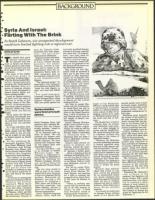
Artwork Irom Newsday by Bob Newman. Copyright. 1991. Newsday. Distributed by Los Angeles Times Syndicate.
anger at the Hezbollah
offensive, which started with
a spectacularly successful
attack on a South Lebanese
Army outpost on May 19, by
staging a series of air raids
on Hezbollah targets, both in
the south and east of Leb-
anon.
The Israelis have vowed to
continue their air strikes
until Hezbollah raids cease,
and, in a clear attempt to
arouse popular disaffection,
Mr. Arens warned of the risk
to Lebanese civilians who
live close to the homes of
Hezbollah leaders.
"Wherever the Hezbollah
terrorist leadership encamps
in densely populated areas
they put at risk anyone who
lives around them," he said.
Senior Israeli sources said
Israel had no interest in war
with Syria and strenuously
denied President Assad's
assertions that Prime Min-
ister Shamir was seeking to
raise tensions in order to win
votes or scuttle the peace
process.
However, they acknowl-
edged that events in Leb-
anon carried the potential
for an uncontrolled escala-
tion. Israeli warplanes were
operating against Hezbollah
bases not only in southern
Lebanon but also in eastern
Lebanon, where there was a
heavy Syrian military
presence.
If an Israeli air strike were
to damage Syrian military
assets or if a Syrian anti-
aircraft missile were to find
its Israeli target, hostilities
between the two states could
escalate swiftly, with un-
predictable consequences on
both sides.
Bubbling away beneath
the surface of this conflict is
the echo emerging from the
power vacuum that was cre-
ated in the Persian Gulf by
the destruction of Iraq's
military capability last year.
A quiet struggle is now de-
veloping between the re-
gion's odd couple, Syria and
Iran, which have been close
allies for the past decade.
Despite the alliance, Syria
harbors deep suspicions of
Iran and fears an expansion
of Iranian influence in the
region. Along with Egypt,
Syria is anxious to form the
core of an all-Arab security
structure for the Gulf that
excludes non-Arab Iran.
The Iranians, however,
have regional ambitions and
have effectively blocked the
creation of any security
structure for the Gulf that
denies them the role of
senior partner.
Following Mr. Mubarak's
visit to Syria at the
weekend, the Egyptian and
Syrian leaders told a press
conference they were plann-
ing to convene a mini-
summit of Arab leaders in-
volving Egypt, Syria and the
six-member Gulf Coopera-
tion Council to discuss pro-
posals for deploying the all-
Arab force. ❑