

rience there than from any
book I read," he says.
Social change still is his
• goal. And he is still fighting
with zeal.
He talks at length about the
1 , importance of the Kroger
worker's strike, stressing the
go importance of bargaining pow
er. He talks about ideals, his
opposition to U.S. involvement
in foreign wars and about
apartheid. He wishes the U.S.
government would have
worked with other nations to
overthrow the apartheid gov-
ernment in South Africa.
"Capitalism doesn't work,"
- he says. "We all gloated about
the failure of communism in
the Soviet Union. We blame
the Japanese for our crisis
here. We are in much deeper
°"'-- trouble than you can ever
Iv imagine.
"Ford, General Motors and
'Chrysler have more auto
workers in Mexico than in the
• United States," he says. "We
. have invested over there, and
we have raped cities like De-
►
' troit."
America, he stresses, has
lost its edge as a superpower.
"Everybody can produce
►
everything," he says. "It was
only a matter of time before
Europe and the Japanese
would catch up."
• Richard Feldman has no re-
grets about his job choice.
Some people think he is crazy.
▪ He doesn't care. He believes
he has made a difference.
11. "For 30 years, American cor-
porations didn't give a damn
about what they produced," he
► says. "They didn't care
whether their Fords would
drive or not. The government
and
the American people
►
should not allow U.S. corpo-
rations to sell out to the rest of
the world. We will destroy the
whole world economy with free
trade."
At least he got to know the
▪ real people, he says.
"Working in the plant pro-
vided a way of keeping my
hand on the pulse of the way
people are thinking," he says.
He offers some advice.
"Remember, without a un-
mion, you have nothing."
Weinhaus'
used
tell him: If he could
solve all of his prob-
lems in one day and
go to bed with a dear mind he
would "have it made."
These were words of wis-
dom for a worker on the line.
"You are like a machine," he
says. "Mere is no time to think
about what you are doing. Af-
ter a while, you can do your job
blindfolded. You daydream.
You think of other things —
projects at home, trips."
Every day at 2:30 p.m., day
shift changes to afternoon shift
at the Ford Truck Plant in
Wayne. At 4:30 p.m., Jerry
Weinhaus, 46, begins his shift.
He works until 1 a.m.
Some workers come to the
plant dressed in shirts mono-
grammed with the Ford in-
signia. They carry lunch
buckets and small coolers to
keep nearby as they assemble
parts for the Ford Bronco and
pickup.
erry
J
They get six-minute breaks
each hour and 30 minutes for
lunch. Lunchrooms are smoke-
filled. It's hard to breathe.
When visitors first enter
the plant, fenders, doors and
frames are visible. They are
stacked and stamped, ready to
move onto conveyer belts that
will carry the pieces to the line.
Bit by bit, piece by piece,
components of the car are
added along the assembly line.
At the end, workers test the
vehicles, driving along a small
course to make sure they are
right.
No one does it any better
than the Americans, Mr.
Weinhaus insists.
American workers are not
dumb, he says, and he is proud
of the product he makes. Noth-
ing makes him more angry
than Japanese auto manufac-
turers calling him lazy and
overpaid. Americans who say
Japanese cars are better don't
understand the business, he
says. That's "hogwash."
He works hard, and he
wants everyone to know it.
"Visualize this," he says.
"You open a door, get in, put
the key in and turn the igni-
tion. Now do this every minute
for an hour for eight hours a
day and tell me you wouldn't
be tired."
For 20 years, Jerry Wein-
haus has worked on the line.
And for 20 years, he has
dreamed of opening his own
business. In another 10 years,
he can retire, collecting full
benefits.
"Then I can do what I
want," he says, adding he
hopes to open a locksmith
shop.
Mr. Weinhaus doesn't look
forward to his assembly-line
job, but he isn't ashamed of it.
He calls it honest work. He is
a quality control inspector,
which means he is the lest per-
son on the line to check a prod-
uct. He inspects chassis for the
trucks.
"I still strive to do other
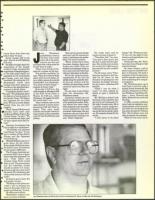
Jerry Weinhaus does not like his job, but he's not ashamed of it. Above, he talks with Jeff Washington.
things," Mr. Weinhaus says.
"If you ever lose sight of your
dreams and aspirations, you
are in trouble."
During the day, Mr. Wein-
haus does many things to hold
onto his dreams.
He takes classes, and he
plans to get an associate's de-
gree in business. He built a
computer at his Livonia home,
and he spends a great deal of
time mastering new comput-
er programs.
Mr. Weinhaus grew up in
Oak Park in what he calls a
typical Jewish household. His
parents, Benjamin and Thel-
ma Weinhaus, had three chil-
dren — Jerry, Howard and
Elliot. Benjamin ran a tool and
die shop.
In 1965, a young, ambitious
Jerry had just started a recy-
cling business with his broth-
ers when he was drafted into
the army during the Vietnam
War. His brothers were not
able to sustain the business.
While he was away, his fa-