

ON THE LINE.
•
•
(7,
R
ichard Feldman calls
himself a patriotic
American. And he
believes all Ameri-
cans should love
their country enough to
change it.
The 42-year-old self-pro-
fessed radical spent 20 years
working on the Ford assembly
line.
To him, a factory repre-
sented the real American
dream. He graduated from the
University of Michigan in Ann
Arbor in the early 1970s and
moved to the Detroit suburb
of River Rouge "so I could live
near the historic Ford Rouge
Plant — the site of crucial bat-
tles that had helped forge the
United Auto Workers."
His reasons were political.
He wanted to organize unions.
Life on the auto line was ex-
citing for Mr. Feldman.
He was hired to paint un-
derbodies (today robots are
used primarily for painting),
but he became better known
among management as a
rebel. He started an employee
newsletter, participated in and
lead walkouts, and encouraged
co-workers to stand up for
their rights.
One of his jobs was stand-
ing beneath a moving line of
trucks and spraying paint un-
derneath the vehicle that was
moving along a conveyer belt
above his head.
That's the way the line
works. Conveyer belts are
everywhere: above worker's
heads, next to the places
where they are standing, be-
hind them.
Piece by piece, people attach
parts to the chassis of a car or
truck as the vehicles quickly
move along a conveyer. There
is little time for a break, few
moments to talk. It is so noisy
that one must shout to be
heard. Bright lights, clean
floors (with the exception of a
few scattered cigarette butts)
and spacious aisles abound.
But the work is narrow, and
those on the assembly line con-
tinue their specific tasks
countless times per hour as
each vehicle advances on the
conveyer.
24
FRIDAY, JUNE 12, 1992
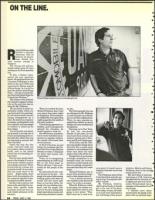
Richard Feldman spends long hours contemplating his role.
When he worked the line,
Richard Feldman knew that
over-spray from paint might
be dangerous. So he constant-
ly watched for over-spray that
might jeopardize the health of
the plant workers.
If something appeared un-
healthy, and if management
ignored the situation, he
would organize a walk-out.
He asked many questions,
but he never lied about his in-
tentions to organize workers.
He wanted a first-hand taste
of real America.
In End of the Line, an oral
history he co-edited with De-
troit Free Press writer Michael
Betzold, he wrote, "I discussed
my ideas with anyone who
would listen."
Today, he is a bargaining
committeeman at UAW Local
900 at the Ford plant in
Wayne. He says, "I am an ad-
vocate for the people of the
plant."
He advocates for the men
and women on the line — the
people who screw bolts among
welding sparks onto doors as
trucks and cars move past
them on conveyer belts, the
people who run robotics equip-
ment, and the people who
strive to do more, taking high
schOol equivalency exams and
continuing education classes
on site.
The Ford assembly line was
an odd place for Mr. Feldman
to work. He grew up in Brook-
lyn in a Jewish neighborhood.
There, he says, parents ex-
pected their children to attend
college and enter professional
occupations.
Growing up in New York,
he had two non-Jewish
friends. At the plant, he was
one of just three Jewish auto
workers, joining Jerry Wein-
haus and Bernie Hamburger.
Of the three, only Mr. Feld-
man says positive things about
the work. But a certain pride
surfaces in conversations with
these men about the final
product that rolls off the line.
Though there is an increase
in foreign competition in au-
tomobile sales, the workers
hold firm in their beliefs that
there is nothing competitors
can make that they can't make
better.
Richard Feldman also is
proud of his Jewish heritage,
and he often boasts about it.
"I am a Jewish American
who worked on the line for 20
years," he wrote in an essay.
When Mr. Feldman worked
in the plant, his mother rou-
tinely asked him when he was
going to law school. "They
didn't raise me to work in an
auto plant. It wasn't secure,
healthy or the best way for one
to live."
The Feldmans skewed the
truth about their son's job, say-
ing he was "in employee rela-
tions" at Ford.
Mr. Feldman, however,
didn't let his family or friends
get in the way of his plans.
Even today, he says, his moth-
er is much more interested in
the well-being of her grand-
children, Micah and Emma
Feldman, than in the social
causes of her son.
His first days of activism
took place at U-M, where he
advocated for the women's, dv-
il rights and anti-war move-
ments. The auto plant was an
extension of his passion for so-
dal change.
"I learned more about
America from the people at the
plant with my personal expe-