
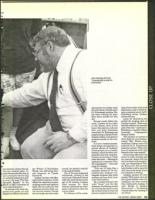

John Eulenberg at the lab:
"Language tells us what it is
to be human."
tant director James Renuk,
who has cerebral palsy, re-
cently became the first man to
use a computer voice to sing
tl.te national anthem at a pub-
lic event. He sang "The Star
Spangled Banner" at the
March 15 MSU-University of
Iowa basketball game.
Or perhaps they need com-
puters that speak not only
English but Hebrew, like Lind-
say Weiner of Huntington
Woods, who will be bat mitz-
vah tomorrow at Temple
Emanu-El.
Lindsay was born with Mar-
shall-Smith syndrome, which
affects her respiratory system
and gross-motor and cognitive
skills. She can walk only with
assistance and has little con-
trol over her motions. Though
she can laugh and utter some
sounds, her speech is basical-
ly incomprehensible.
One of 18 cases diagnosed
nationwide, Lindsay is the
only known Marshall-Smith
child who has lived beyond the
age of 20 months. Lindsay
lived because Dr. Benn
Gilmore performed an emer-
gency tracheotomy when she
was an infant.
Dr. Gilmore will be watch-
ing tomorrow as Lindsay reads
from the Torah with the aid of
Dr. Eulenberg's machine. She
has been working for more
than three months for this
day.
Several weeks before the
event, Lindsay sat at a table
in the dining room of her
home. Her parents, Judi and
Neil, and John Eulenberg
were there. Dr. Eulenberg was
programming a keyboard with
designs Lindsay must press to
generate sounds on the com-
puter.
It is not a random process.
Each design corresponds to a
certain phrase of Lindsay's
Torah portion or to a bracha,
blessing, which has been pro-
grammed into the computer.
Lindsay is learning in which
order and when — allowing for
appropriate responses from
the congregation — she must
press the designs.
"This sort of looks like a
mezuzah, doesn't it?" Dr. Eu-
lenberg says, holding a rec-
tangular computer chip which
contains phrases from Lind-
say's Torah portion.
He is programming in the
word "Amen" and the She-
hecheyanu, the blessing recited
for reaching this point in one's
life. In front of him is what will
become Lindsay's keyboard, a
large white surface with small
black boxes, each of which di-
rects a computer sound. As Dr.
Eulenberg works, Lindsay
strokes his face.
Later, Dr. Eulenberg will
perfect the singing voice on
Lindsay's system. "Rashi says
that the melody is an essential
part of the text," explains Dr.
Eulenberg, a member of East
Lansing's Congregation
Shaarey Zedek.
"All parents are proud of
their children's accomplish-
ments," Mrs. Weiner says,
watching Lindsay learn the
patterns on Dr. Eulenberg's
computer system. "When you
have an impaired child, that
becomes even more special."
Several days afterward, the
device is ready. Lindsay and
her parents, along with her
three brothers and grandpar-
ents, are rehearsing at Tem-
ple Emanu-El. Her parents
help Lindsay walk to open the
Ark, then to the bimah where
her computer is waiting.
Lindsay presses the first
symbol. What comes out is not
the typical robotic voice of a
computer, but what sounds
like a little girl's singing. It
calls Barchu at Adoshem
Hamevorach — the blessing
recited before the reading of
the Torah.
THE DETROIT JEWISH NEWS
23