
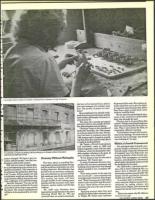

A porcelain factory outside of Dresden: Unemplyment is between 30 and 50 percent.
And now we've learned if you stick to
your own business, it's a dream come
true. The profits of peace are enor-
mous."
But reunification has already weak-
ened that strong economic base and the
social welfare philosophy Germany be-
came known for.
The story of a recently privatized
porcelain factory just outside of Dres-
den demonstrates such problems.
Christian Tassin is the president of
Sachsishe Porcellan, the 19th compa-
ny to be privatized in the east. The fac-
tory has been in existence since the
18th century and is located in a build-
ing that from the outside looks like it
is ready to be demolished.
Mr. Tassin, a French businessman
and economist, came in 1990 and
helped negotiate a deal with the state
of Saxony, where he donated the valu-
- The contrasts in Dresden are striking: Half the buildings are in disrepair, while in other places
able porcelain collection to the state. In
businesses are beginning to thrive.
turn, all debts were written off.
"It was cheap to buy but the risk is
Economy Without Philosophy
system changed. We have to get con-
enormous,"
Mr. Tassin says.
nection with the people," who don't un-
In many businesses the new own-
The fears about a reunified Ger-
derstand a democratic system.
ers face old, run down equipment and
many again trying to dominate Europe
With only two years in elected office,
buildings
and a labor force way beyond
and the world are unfounded, say some
he is just beginning to be critical of es-
what
is
needed
to run a company effi-
leading
observers.
Reunification
has
tablishment politics. "The insecurity is
ciently.
proved to be an enormous undertak-
here because the politicians didn't say
Thus many people in the east are
ing; cost estimates run around 150 bil-
it all," he says. At first, people were told
now
out of a job — some estimates say
lion marks per year for the next decade.
reunification would not cost them. But
unemployment
is between 30 to 50 per-
The
country,
say
many,
will
have
as government officials learned the real
cent. "West Germany gave 260 billion
enough trouble in the coming years
costs, politicians were not forthcoming.
marks to the cost of the east this year,"
dealing with the economic crisis, labor
Says Mr. Schwarz: "You can see the
he says. "Sixty billion of that was in-
disputes, asylum seekers and foreign
old way to practice politics for the east
vestment; the rest is the cost of unem-
workers.
and west is not the way it can work for
ployment."
Mr. Joffe says Germans have
the future. The western establishment
Applying western labor laws and
learned two crucial lessons in the years
will have to be questioned by new peo-
standards
makes labor extremely cost-
following World War II. "We got
ple."
ly. Wages, Mr. Tassin says, represent
screwed when we tried to dominate.
80 percent of his costs. His workers ac-
tually asked him not to give the legal-
ly required raises because they knew
that those raises would mean some
workers would be fired.
He too cites the psychological pres-
sures as the westerners steamrolled
their way through the east.
"There is lots to be saved from this
culture. Things were functioning here
that were not so bad, like the scthal sys-
tem. There were places for kids, no
criminality, efficient recycling.
"Communism was not only an econ-
omy but an ideology. We came with an
economy but no ideology, and people
were missing it," he says.
Within A Jewish Framework
The principal task of Jewish com-
munity leaders in Munich is to keep
"Jewish youth within the framework
of Judaism" says Chil Rakowski, the
'executive director of the Jewish com-
munity. Folur synagogues, one kosher
butcher, a kindergarten, elementary
school and a community center provide
the backbone for the task.
Mr. Rakowski, a dynamic gentle-
men with a shock of graying hair, ex-
plains that in Munich the Jewish
community numbers around 5,000. The
largest Jewish population, between
10,000 and 15,000, is in Berlin.
In a system alien to Americans, Ger-
many supports religious communal in-
stitutions by taxing citizens who
declare their religion, then funnels the
money from the tax to the various agen-
cies.
That is one reason why Mr. Rakows-
Continued next page
THE DETROIT JEWISH NEWS
27