

WWI I 1-1-Z1VA
H ERQES
'What's he thinking?' "
The second time he brought
his photo album.
Near the end., the man could
no longer speak. He suffered
with dementia. He wouldn't
watch television or listen to the
radio. Nurses had to move him
constantly so he wouldn't get
bedsores. He was 38 when he
died.
For eight months, Mr. Elkus
went each week to see the sick
man. As to why he took time to
visit someone he had never
known, someone who often did
not even know he was there, Mr.
Elkus says simply, "Could you
imagine sitting alone for 24
hours, day after day, and no-
'Jody coming by?"
One of Mr. Elkus' earliest pro-
iects was serving with the Jew-
ish Family Service Special
Friend program. He volunteered
as a big brother for a Jewish boy
from a troubled home. For sev-
n-al years each week, he took
'le boy bowling and to movies
w id to baseball games.
If fall is for JARC and Bor-
man Hall, winter may be Mr.
busiest season. That's
when he volunteers at Sinai, the
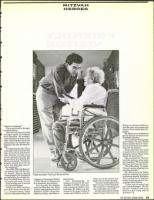
"People are people. They're just like you and me."
Coalition on Temporary Shelter
(COTS), Meals on Wheels and
at a downtown soup kitchen.
And through his clothing
store, the Shirt Box, Mr. Elkus
collects used clothing which he
donates to COTS, a drug reha-
bilitation facility, and other or-
ganizations.
Last Thanksgiving, he
dropped off some of the mer-
chandise to COTS, which pro-
vides temporary shelter to the
homeless. Mr. Elkus was dis-
tressed by the large number of
women and children at the fa-
cility; one of the newest resi-
dents was a 3-week-old child.
"You and I could easily be like
that," he says of the homeless.
"We could lose everything, and
who would take care of us?"
He also takes time for Jewish
seniors living in the inner city.
He'll go on Jewish holidays to
visit the men and women who
he says "have really been for-
gotten."
Mr. Elkus never hesitates to
get his friends involved in his
charitable activities.
"I'm constantly hitting people
up for money," he says. And he
tries to inspire them to volun-
teer by showing his own enthu-
siasm for the projects.
At the same time, he's quick
to insist he is by no means ex-
ceptional, saying, "Many of my
friends do more than I."
One comment for which he
has little patience when seek-
ing volunteers: "I'd love to help,
but I just don't have the time."
'We all have time," he insists.
"It's just a matter of getting your
priorities straight."
Mr. Elkus gives his father
credit for inspiring his interest
in volunteer projects. His father,
Phil, is active in the Yad Ezra
kosher food bank and at Con-
gregation Beth Shalom
"I often look at myself and
say, am so fortunate,' " Mr. Ek-
lus says. "I think it's part of my
duty as a Jew to pay some of
that back." ❑
THE DETROIT JEWISH NEWS
67