

FOCUS
The Kindness of Strangers
HOW
ELIZABETH APPLEBAUM
Assistant Editor
s
eventy-five years ago
this month a young
immigrant decided to
change the face of the
Detroit Jewish community.
His name was Samuel
Sandweiss, and he was ap-
palled to discover upon settl-
ing here that Detroit Jews
often did not have enough
money to bury their dead.
So Mr. Sandweiss began a
fund-raising campaign. He
and his friends organized
picnics and bazaars. In no
time they had collected
enough to purchase land for
a cemetery and a chapel,
named Hebrew Memorial,
and to pay for funerals for
indigent Jews.
Today, the Hebrew
Benevolent Society con-
tinues to provide free Jewish
funerals for those who
cannot afford them. But the
vast majority of its clientele
— despite its image to the
contrary — is neither poor
nor Orthodox.
In conjunction with the
75th anniversary, the
Benevolent Society will hold
a dinner May 31 at the
Hyatt Regency.
The Hebrew Benevolent
Society was founded in 1916
as the Chesed Shel Emes
Society, a term referring to
kindness done with no ex-
pectation of reward. Outside
the Jewish community, it
was known as the Jewish
Free Burial Association.
Its first office was in a
house shared with Isaac
Korotkin on Brewster
Street, east of St. Antoine.
The house was in the lower
Hastings neighborhood,
Detroit's Jewish immigrant
ghetto from the 1880s until
the 1920s.
The Society paid the rent
with dues — by the end of its
the dreams
of a young immigrant became
the Hebrew Memorial Society,
now celebrating its 75th
anniversary
first year, it had 1,000 mem-
bers — which were 5 cents
weekly.
Not long after its forma-
tion, the Society purchased
land for a cemetery at
Gratiot and 14 Mile roads.
All streets in the area were
unpaved then, and it took
almost half a day to bring
the casket, carried by, horse
and buggy, to the cemetery.
Around 1923, Chesed Shel
Emes relocated to its own
building at 535 Frederick,
between Beaubien and St.
Antoine in the upper
Hastings neighborhood. It
remained there until 1932,
when it moved to 2995 Joy
Road, near Lawton, part of
the Linwood neighborhood.
The building on Frederick
became a Masonic temple.
By the late 1960s it became
a Baptist church, and has
since been demolished. The
house on Brewster, like the
street itself, no longer exists,
having been replaced by
1-75, the Chrysler Freeway.
In 1940, the organization
formally changed its named
to the Hebrew Benevolent
Society-Chesed Shel Emes.
The change alluded to an
earlier charitable organiza-
tion, called the Hebrew
Benevolent Society, which
existed in Detroit at the turn
of the century.
In 1965, it left Joy Road
and moved to a new building
in Oak Park, where it re-
mains today.
Hebrew Memorial's burial
procedures have not changed
since . its founding. What has
changed is the nature of the
Jewish community the socie-
ty serves.
Years ago, few Jews were
interested in being embalm-
ed and virtually no one con-
sidered the question of "Who
is a Jew?" Both of these
could pose problems at a fu-
neral home which seeks to
serve the entire community
and, at the same time,
adhere to the doctrines of
Halachah — Jewish law.
Hebrew Memorial's posi-
tion is to be flexible when
possible says Rabbi Boruch
Levin, executive director of
Chesed Shel Emes. So, for
example, families are per-
mitted the use of flowers.
"Is it the right thing to do?
No." Rabbi Levin says. "But
it's not Strictly forbidden by
Halachah."
And while Hebrew
Memorial will not do em-
balmings or cremations or
allow open caskets, diversity
is possible.
Caskets are on display in a
back room of the chapel.
They come in 13 styles,
ranging from plain wood to
Honduran mahogany.
Rabbi Levin insists there's
never any hard sell, that the
more expensive models are
an option, but not encour-
aged.
"When people ask me,
`What should I buy?' I tell
them, 'What you feel comfor-
table with,' " he says.
"There's no need to spend a
lot of money."
"At the time of death, the
.
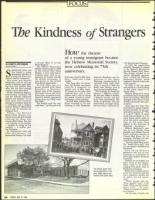
The Detroit Jewish Free
Burial Association in the
early 1900s, above, and
Chesed Shel Emes today.
54
FRIDAY, MAY 15, 1992