

AMY J. MEHLER
Staff Writer
S
gt. Heinz Jost had a
unique wish for his
40th birthday. He
wanted a look inside the War-
saw Ghetto.
On Sept. 19, 1941, Sgt.
Jost, a hotel keeper from the
town of Langelensheim,
went with his camera into
the ghetto. He was serving
as a sergeant in a German
army transportation unit on
the east bank of the Vistula
near Warsaw. -
Sgt. Jost spent his birth-
day in the Warsaw Ghetto
and photographed every-
thing he saw, taking 129 pic-
tures. The trip was a risk be-
cause entry into the ghetto
by Germans was forbidden
by law. .
"A Day in the Warsaw
Ghetto: A Birthday Trip in
Hell" is on exhibit from
May 7-June 11 at the Janice
Charach Epstein Museum
Gallery at the Jewish Com-
munity Center in West
Bloomfield. The exhibit,
which presents 85 photos,
travels nationally through
March 1995 under the
auspices of the Smithsonian
Institution Traveling Ex-
hibition Service.
"I was in the camp for
several years," Sgt. Jost,
now dead, wrote in letters
never before published. "On
my journeys, I observed
many dead bodies lying
along the ghetto wall. I went
in without difficulty,
wandered around in the
streets behind the walls and
photographed what I saw.
Until then I knew nothing
about what was happening
behind the walls."
The photographs remained
in Sgt. Jost's possession,
hidden from his family, until
1980 when he gave them to
the editors of the German
periodical Der Stern. The
collection was never
published. Editors sent
reporters to interview Sgt.
Jost; the interview and pic-
tures gathered dust in the
magazine's offices. Six years
later Sgt. Jost died..
In 1987, the magazine
gave the photographs to the
Yad Vashem Archives in
Jerusalem. Until 1988, the
photos had never been
published or publicly
displayed.
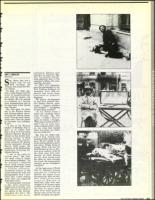
The photos, accompanied
by text from selected War-
saw Ghetto diaries, show
people — beggars, peddlers
and children — struggling
for their daily existence.
"In my letters home I
didn't say anything about
what I'd seen," Sgt. Jost
wrote. "I didn't want to
upset my family. I thought,
`What sort of world is this?' I
didn't tell my army com-
rades anything either. Later
on, too, when they burned
down the ghetto, we didn't
pay any attention."
Sgt. Jost saw shops emp-
tied of food, selling only
laundry powder and pots and
pans. He saw people in the
street selling potatoes, garlic
and celery. People dying of
hunger didn't ask him for
food because he was in Ger-
man army uniform. A few of
the Jews were still well-
dressed, he noted. During
the day, Jews carried away
the dead on carts through
the streets. He photographed
common graves throughout
the ghetto.
At the beginning of World
War II, Warsaw's Jewish
population numbered
380,000, the largest of any
European city. After the Ger-
man army's three-week
siege on Warsaw in
September 1939, Jews were
stripped of all human rights
and forced to live in an area
less than 21/2 square miles.
Jews from other parts of
Europe were moved into the
ghetto, bringing the popula-
THF
nF7orr JEWISH NEWS
69