

Impressions Of Israel
Had our men been through here, I
wondered. Beyond the second arch
lay King Feisal Street, a brief,
narrow, covered, tunnel-like lane,
closed at the far end by a wide gate
with a small wicket where
pedestrians entered. This, too, was
closed, but the bolt was not locked.
We stepped through, and the breath
caught in our throats.
We beheld the huge paved
courtyard, crowned, against the blue
sky of June 7, 1967, (the 29th day of
the month of lyar in the year 5727),
by the golden cupola of the Dome
of the Rock, gleaming, glistening,
taking its gold from the sun.
A spectacle of legend.
We ran toward Motta Gur,
standing on the Mount, where the
flag of Israel flew. We were joined
first by Moshe Stempel, Motta's
deputy, and then by Rabbi Goren.
We embraced and the Rabbi
prostrated himself and genuflected
toward the Holy of Holies. In a
resonant voice he recited the
ancient Prayer to Battle
(Deuteronomy 20:3-4):
Hear, 0 Israel, ye approach this
day unto battle against your
enemies; let not your hearts faint,
fear not, and do not tremble, neither
be ye terrified because of them; for
the Lord your God is he that goeth
with you, to fight for you against
your enemies, to ,save you!
We made our excited way
through the streets to the Mugrabis'
Gate, along a dim alley, turned right
down a flight of steps, impatiently
faced another right turn — and
there it was. The Wailing Wall. I
quivered with memory. Tall and
awesome and glorious, with the
same ferns creeping between the
great stones, some of them
inscribed.
Silently I bowed my head. In
the narrow space were paratroopers,
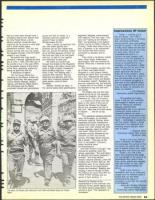
The author, Uzi Narkiss, left, entering the Lion's Gate with Moshe Dayan and Yitzhak
Rabin.
begrimed, fatigued, overburdened
with weapons. And they wept. They
were not "wailing at the Western
Wall," not lamenting in the fashion
familiar during the Wall's millennia
of being. These were tears of joy, of
love, of passion, of an undreamed
first reunion with their ancient
monument to devotion and to
prayer.
They clung to its stones, kissed
them, these rough, battle-weary
paratroopers, their lips framing the
Shema. Returned, it seemed to the
Temple ...
But more exalted, prouder than
all of them, was Rabbi Goren.
Wrapped in a talit (prayer shawl),
blowing the ram's horn, and roaring
like a lion: "Blessed be the Lord
God, Comforter of Zion and Builder
of Jerusalem, Amen!" Suddenly he
saw me, embraced me, and planted
a ringing kiss on my cheek, a signal
to everyone to hug and kiss and
join hands.
The Rabbi, like one who had
waited all his life for this moment,
intoned the Kaddish, the El Moleh
Rahamim (0„ God, full of mercy
...), in memory of those who had
fallen in the name of the Lord to
liberate the Temple, the Temple
Mount and Jerusalem the City of
the Lord: "May they find their peace
in Heaven ... and let us say
Amen."
The restrained weeping became
sobs, full-throated, an uncurbed
emotional outburst. Sorrow, fervor,
happiness and pain combined to
produce this mass of grieving and
joyous men, their cheeks wet, their
voices unsteady. Again the shofar
was blown: tekiya (a short, but
unbroken sound), followed by the
shevarim (a short but tremolo
sound). And Rabbi Goren intoned,
like a herald: "This year, at this
hour, in Jerusalem!" (le-shana
hazot, be-sha'a hazot,
be-Yerushalayim).
Until that moment I thought I was
immune to anything. Even the
stones responded. "We shall stand
at attention and salute! Attention!" I
shouted. "And sing Hatikva"
(Israel's national anthem), came the
choked voice of Haim Bar-Lev. We
started to sing. To our voices were
added those of the paratroopers,
hoarse and indistinct. Sobbing and
singing, it was as though through
the Hatikva we could unburden our
hearts of their fullness and our
spirits of their emotion. ❑
General Uzi Narkiss is the
representative of the chairman and
treasurer of the Jewish Agency and
the World Zionist Organization. This
excerpt is from "The Liberation of
Jerusalem."
"Unity — knowing you're
part of a whole. This I felt in
Israel. While bobbing in the Dead
Sea, schvitzing at Masada,
touring ancient ruins, and walking
through Jerusalem, I felt the spirit
of many more before me that had
done the same, and like me, they
too were Jews. That is how
remarkable this land is. It
contains the past, present, and
future all in one. For example, at
one time the Jordan River was a
source of nourishment for our
ancestors. At the present I rafted
down the river for fun and in the
future, it will serve as a major
power source for the land of
Israel. All of this evoked a sense
of pride in me that I am a Jew. It
was just being able to see the
work of my people struggling to
hold onto a land rightfully theirs.
It is this elegance that is sure to
draw me back: my ancestry, my
family, my children."
— Erin Madorsky
Community Jewish High School
The greatest part about
Israel is that you are constantly
encouraged to explore as you
learn its history (ie: climbing
Masada, planting trees,
archeological dig). It is a genuine
melting pot where history is
happening before your eyes —
we flew on the same plane which
carried Ethiopian Jews on its last
flight! — technology is advancing,
and the Jewish religion is being
preserved! It is a beautiful and
amazing country that you never
want to leave."
— Marjorie White
Community Jewish High School
(Graduate 1991)
"Israel to me is the climb at
dawn to Masada, the beauty of
the landscape, the sunrise on the
mountains, the feeling that I am
part of Jewish history, that I really
belong here, that this is my land.
"Israel is my visit to the
Kotel, the excitement that swept
me, the thought of the Jews of all
generations who came to pray
here, all the wishes and requests
that were written on little notes
that were pushed between its
stones.
"Israel is the market in
Jerusalem, with all its colors and
shapes and the different kinds of
people that you see there,
symbolizing the nature of
Jerusalem, a city holy and sacred
to all religions."
—Nira Lev's Sunday Morning
Advanced Hebrew Class
Community Jewish High School
THE DETROIT JEWISH NEWS
63