

DETROIT
Doctor Races To Bring Attention
To Medical Cares Of Children
ELIZABETH APPLEBAUM
Assistant Editor
F
orget the colorful
drawings of the heart.
Forget the medical
textbooks with unpro-
nounceable names. Forget
the stethoScopes, the syr-
inges, the white jackets.
The most prominent
feature of this doctor's office
is the racing paraphernalia.
Director of the cardiology
division at Children's
Hospital of Michigan, Dr.
William Pinsky has been a
racing aficionado for as long
as he can remember. Now
he's combining that passion
with his professional inter-
est in children's medical
care.
Dr. Pinsky is the force
behind Racing for Kids, a
national program to promote
awareness in and raise funds
for children's hospitals
throughout the country.
Racing for Kids has just
begun its second season,
with local fund-raising
Dr. William Pinsky
efforts to include a May 27
raffle of a 1992 Buick Park
Avenue Ultra. The car will
be presented during the Rac-
ing for Kids drivers' annual
visit to Children's Hospital,
prior to the Detroit Grand
Prix.
Dr. Pinksy, who also
serves as vice chairman of
the Wayne State University
department of pediatrics,
several years ago came up
with the Racing for Kids
idea. But it wasn't until he
consulted Williani Harr-
ington and Patrick Wright,
both of whom had extensive
backgrounds in marketing,
that he figured out how to
get the project off the
ground.
"We stumbled around for
about a year," Dr. Pinsky
admits. Appealing to big-
name drivers, like Mario
Andretti and Al Unser, was
out of the question. "They're
too busy," Dr. Pinsky ex-
plained.
Then the three thought of
attracting young, up-and-
coming drivers in the mid-
level professional racing cir-
cuit.
Their first recruit was
Robbie Buhl, a national
champion in the American
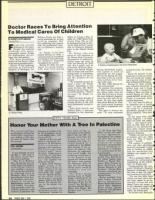
A Children's Hospital patient with driver Robbie Buhl.
Racing Series/Indy Lights,
who agreed to serve as
spokesman for the project.
He has the Racing for Chil-
dren logo on his car and do-
nates a portion of his winn-
ings to the cause.
By May 1990, Racing for
Kids was launched.
To promote the program,
Mr. Buhl travels from city to
city where major races are
held. His first stop is always
the local children's hospital,
where he visits with the pa-
tients. He also does media
spots about Racing for Kids,
and fund-raising programs
are held in conjunction with
his stay.
The goal is always the
same: "To raise awareness
FIFTY YEARS AGO
This column wa ll
weekly feature duri
Jewish News' anniversa ry
year, looking at The Jew-
ish. News of today's date
50 years ago.
L JACOBS
Managing Editor
It was, perhaps, an ad in
the May 1, 1942, issue of
The Detroit Jewish News
that said everything.
"May 10 is Mother's
Day. On that day you will
surely honor your mother,
or you will pay tribute to
your mother's memory.
You can do this good deed
by planting trees in
Pales
: Here is what
tree planting in Zion does.
It increases land pur-
chases in Palestine.
Reforestation makes the
land fruitful. Tree plan-
ting provides work for
Jewish pioneers and
makes it possible for,
14
FRIDAY, MAY 1, 1992
of a tree, 7
Reports iS
Hitler's continuin
astation of European
Jewry continued to
dominate the headlines.
The front page lead
headline read, "Nazis
Slaughter 13,000 Jews in
Lwow; Report 1,500 More
Died In Radom Of Starva-
tion." The headline was
printed in red ink.
A photo of Sir Norman
Angell, winner of the
Nobel Peace Prize in
1933, appeared on the
front page. Mr. Angell
was the keynote speaker
at the Allied Jewish
Campaign's opening
dinner, held at the Hotel
&Mier. 'The cost per per-
son for the dinner was
$2.50.
Noted author Pierre van
Paassen wrote an
"exclusive" column in
Ave
tainly headed for :"a
rendezvous in the Middle
East because of the re-
gion's oil reserves. The
obstacles, he suggested,
that would hinder the
rendezvous would have to
be the Russian Army
against the Germans and
the Indian Army against
the Japanese. Also, he
said, the 200,000-strong
Jewish Army would be
needed to stop the
onslaught.
The Wider Scope
bowling team of Pisgah
Lodge, captained by Al
Sklare, captured the
Michigan B'nai B'rith
Council Cup. Members of
the team included Martin
Miller, Sam Ha.ssin, Ben
Dolgin and Charles
Rassner.
tablx5hmerl
.
Of a national
Jewish people.
Marriages this w ed
chided: Irma Horwi
Pvt. Albert Pasick, Jan
Pfeiffer to Morley ;
Jarnin, Mimi ScheYett;
Hans liatcheck, an
Miriam Ec wai to Aid
Kushner. .:Rita
Neuman anno
engagement
Herbert Fealk.
Births included.
Jane Cohen, Leonar
Martin Herskowitz,
Stuart Gerald Leff ;t
Jerome Sklar, StSt0i*t
Ellen Atkins, Danie-
Redstone and Machae
k
Robert Kaplan
to help the kids," Dr. Pinsky
said.
About 95 percent of the
funds stay in each city where
they are raised; the remain-
ing 5 percent comes to Chil-
dren's Hospital of Michigan.
Racing for Kids already
has collected thousands of
dollars. Last year in Long
Beach, Calif., a Grand Prix
Celebrity Race was held to
benefit Racing for Kids. It
raised $40,000. As far as Dr.
Pinsky is concerned, that's
just the beginning.
"It's very easy for kids to
be legislated out of health
care," he said, explaining
the need for a program
specifically geared to chil-
dren's hospitals. "They don't
vote."
At the same time, chil-
dren's hospitals — of which
there are some 122 nation-
wide- — face special prob-
lems, he said. They are ex-
pensive to run because chil-
dren often require round-
the-clock care, and may need
extensive diagnosis.
"Unlike you and me, a lot
of children can't say, 'This
hurts me. This is what's
wrong,' " he said.
The number of pediatri-
cians and other physicians
primarily interested in child
care is limited, he added.
And the specialized care
children can require is ex-
pensiVe.
"It's a constant battle to
expand the technological
capabilities of the institu-
tion," Dr. Pinsky said.
Compounding the non-
profit Children's Hospital
financial challenges is the
fact that it does not refuse
any treatment to any child.
"It's not the kid's fault
that he was born with a seri-
ous heart defect to an-un-
married 17-year-old who
doesn't have any money, or
to the suburban couple who
only have a medium in-
come," Dr. Pinsky said.
In its first year, Racing for