

FOCUS
Cathering the Remnants
F
first, she had only silence.
Then she learned to
scream.
Next, the psychiatrist
taught her to cry.
Then she told her story:
a true tale of live demons
and nightmares and death
and agony, of her years in a Nazi
death camp.
The girl — her name is not reveal-
ed — lost her voice during the war. It
came back, years later, in a dis-
placed persons camp. Her story is the
first on a new program written and
produced in Ann Arbor which will
air this month on National Public
Radio stations throughout the coun-
try.
"Remnants" is a collection of sur-
vivors' stories by Hank Greenspan,
a University of Michigan professor
and clinical psychologist. His work
on the project began 15 years ago,
when he was a student in New York.
Dr. Greenspan's initial interest
was in the Civil War. Then he met
his cousins, Holocaust survivors,
while visiting Israel, "and I started
realizing the Civil War wasn't the
war I wanted to know so much
about."
In graduate school, he decided to
combine his interests in history and
psychology. He began meeting with
survivors who, he discovered, "are
not people who have been listened to
well."
Too often, he said, survivors find
themselves turned into heroes, men
and women supposedly full of in-
sight and wisdom. Others consider
them objects of pity. Both are ways
of "talking about, not with, sur-
vivors."
Dr. Greenspan's approach was to
bring along a tape recorder and let
the survivors speak for hours,
uninterrupted. He would meet with
them on numerous occasions —
sometimes up to 11 times — until
Dr. Greenspan would hear "the
story behind the story, then the
story behind that story."
He found himself drawn in, in part
because he hoped to understand the
terror, in part because "I had the
fantasy that I would find some
meaning in all of it," in part because
"it reached a point where I felt like I
missed those people — the people
who used to be.
In voices
of terror, anguish
and silence, Holocaust
survivors tell their
stories through an
Ann Arbor professor.
ELIZABETH APPLEBAUM
Assistant Editor
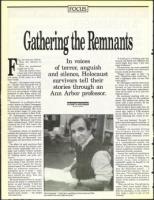
Hank Greenspan: "I would go to a wedding and look around and think
how different the world might have been."
"I would go to a wedding and look
around and think how different the
world might have been. I felt that
sense of absence."
The survivors, too, were compelled
to continue to speak, even when their
horrors would not leave them.
"People were eager to talk," he
said. "Sometimes they would say, 'I
had a nightmare after we met. But
come again.' "
Dr. Greenspan used the interviews
to write his dissertation, which
focused on how survivors speak
about their Holocaust experiences,
what drives them to do so and how
listeners react.
He continued meeting with sur-
vivors years after he left graduate
school. His method was always the
same: take a tape recorder; let the
conversation be spontaneous.
But he didn't know quite how he
would use the material until several
years ago, when a U-M student
group asked him -to write a few
scenes featuring the voices of sur-
vivors.
"I was very hesitant," he said. "I
didn't know how good it would be, or
if I could do it without trivializing
the topic."
Instead, he started writing
monologues based on the
testimonies he had recorded — a pro-
ject that would eventually evolve
into "Remnants."
He started with what he described
as a "quintessential moment, the
stories and reflections that stayed
with me." Some were combined and
almost completely rewritten; others
remained virtually verbatim.
Among the unaltered monologues
is .a survivor's description of a
prisoner, in charge of keeping the
toilets clean, who creates a
makeshift vanity for herself in the
bathroom at Birkenau.
"Whenever people ask me, 'What
does the Holocaust mean?' . .
think about this memory," the sur-
vivor says. "Try to keep the picture,
all the elements of the picture
together in your mind at one time: A
vanity. In the latrine. In Auschwitz-
Birkenau.
"Now you tell me. You tell me be-
cause I don't know myself. Does it
inspire your hope or your revulsion
that the attendant, in the toilets of
hell, made a place to put on her
makeup."