
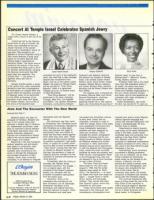

Concert At Temple Israel Celebrates Spanish Jewry
For Cantor Harold Orbach, it
began with a return to the city of his
birth.
Invited last fall by the German
government to sing in concert, the
cantor was contacted by the non-
Jewish historian of the Jewish
community in Dusseldorf, where he
was born. She brought to his
attention a concert originally sung in
1921 which featured a song cycle
based on the great Spanish poet
Yehuda Halevi, composed by
Heinerich Shalit. The cantor was so
moved by the beauty of the music,
he included this song cycle in all of
his German performances, showing
the German community that 500
years after the expulsion "Am
Yisrael Chai" — the poetry of
Spanish Jewry still lives in
Germany.
Several months earlier, a group
of 20 cantors from cities nationwide
decided to ask their congregations
to commission an original work that
would reflect the grandeur and glory
of Spanish Jewry, to be performed
on the 500th anniversary of the
expulsion of the Jews from Spain.
For Cantor Orbach, the survival of
the lyrics of the Spanish poet
Cantor Harold Orbach
Gregory Gyllsdorff
Alicia Hunter
embodied the spirit of the Sephardic
Jews, who held fast to their heritage
despite their banishment from
Spain. And so, to the cantor's great
delight, the poetry of Yehuda Halevi
will be included in "Ever Since
Babylon" when it is performed
Tuesday at 8 p.m. at Temple Israel
in West Bloomfield.
"Ever Since Babylon" will be
performed in 20 cities, including
Chicago, New York, Los Angeles
and Detroit. The Jackson Symphony
Orchestra, conducted by Gregory
Gyllsdorff with Stephen Osmond,
will perform the concert at Temple
Israel, with soloists Cantor Harold
Orbach, tenor; Alicia Hunter, mezzo-
soprano; Martha Warren, soprano;
and Cantor Richard Allen, baritone.
Narrating will be Evelyn Orbach and
Paul Winter.
The original work, composed by
Professor Samuel Adler and Cantor
Samuel Rosenbaum, combines
music, poetry and narrative
depicting Jewish life in 15th century
Spain and chronicling the journey of
Spanish Jewry to new lives in
strange lands — Morocco, Tunisia,
Turkey, Albania, Greece.
Professor Adler has to his credit
more than 300 published works in
all media. His works have been
performed by major symphonic,
choral and chamber organizations in
the U.S., South America, Europe
and Israel, and he has appeared as
conductor with major orchestras in
the U.S. and abroad.
Cantor Rosenbaum, who wrote
the text, has served for 41 years as
connected with Columbus' venture
at entry level. Some, like his
interpreter, converted in order to
make the voyage. Many of the maps
and navigational instruments that
made transatlantic exploration
possible had been designed by
Jews and conversos. These
included the Jewish cartographer
Abraham Cresques and his son
Jefuda (known as Mestre Jacome
de Mallorca following his forcible
conversion in 1391); astronomer
Abraham Zacuto (court astronomer
to both the Spanish and Portuguese
kings, exiled from both countries
because he would not convert); and
Pedro Nunes, Cosmographer Royal
to the Portuguese king, who was
not allowed to live at court because
he was a New Christian.
The Nina, Pinta and Santa
Maria sailed on the same day,
August 3, 1492, that the exiled
Spanish Jews sailed for North
Africa. The Sephardim — as Jews
are called who trace their origins to
Spain — sought haven in North
Africa, Turkey, and eventually,
Holland. They carried with them
their Spanish culture, which they
preserved for 500 years.
These communities were largely
destroyed in the Holocaust. But
contemporary ethnographers and
linguists who wish to study fifteenth
century Spanish language and
culture still interview Sephardim now
living in Constantinople, Tel Aviv,
Buenos Aires or Seattle.
Determined to extend Spanish
royal policy to the newly discovered
lands in the West, Queen Isabel
prohibited Jews and conversos from
settling in the New World. Neither
their Spanish culture nor their
technical or intellectual contributions
qualified conversos for entry. Only a
few came to the New World through
loopholes in the law.
Astonishingly, some conversos
succeeded in leading productive
lives, but as Catholics, not as Jews.
These included the Dominican
priest known as the Apostle to the
Indians, a Mexican nun who
became the colony's premier poet,
the world's first ethnographer, and
the lawyer who compiled the law
code of the Indies. Not all
conversos were saints: the bloody
conqueror of Panama had converso
(along with Old Christian) origins.
The mind set imposed by 350
years of living under the rule of the
Holy Office of the Inquisition is
1492's principal legacy to Spanish
America (from the Rio Grande to
the tip of South America) and to a
lesser extent, to Portuguese
Jews And The Encounter With The New World
Continued from Page L-1
Medieval Spain has been an
amalgam of Christian, Moslem and
Jew, a rich cultural milieu that
spawned a Golden Age of literature,
art, mathematics and music. Jews
were an important cultural element
in the Spain Columbus knew, and
Jewish scientists, statesmen,
linguists and entrepreneurs played
roles in the rise to world power of
both Aragon and Castile.
Beginning in the late fourteenth
century, pogroms and anti-Jewish
laws began to marginalize Jews
from Spanish life. Uncounted
numbers were converted by the
sword or through the kidnapping
and forcible conversion of their
children. Other Jews converted
voluntarily, in an attempt to integrate
,
Lfehaidn
THE JEWISH NEWS
27676 Franklin Road
Southfield, Michigan 48034
March 27, 1992
Associate Publisher: Arthur M. Horwitz
Jewish Experiences for Families
Adviser: Harlene W. Appelman
L 2
-
FRIDAY, MARCH 27, 1992
themselves fully into Spanish
society.
But whichever way they came
to Christianity, New Christians found
themselves increasingly regarded by
Old Christians as a class apart.
Soon they became the target of
exclusionary laws very similar to
those that had been aimed against
them when they were Jews. These
laws required that anyone wanting
to practice a profession, hold public
office, or qualify for a public honor
must be able to show a certificate of
"clean blood" proving that they had
no Jewish or Moselm ancestor. In
this way, the exclusion of Jews on
religious grounds changed into the
exclusion of converts (conversos) on
racial grounds.
Immediately after the victory at
Granada, the Catholic Kings
chartered Columbus' first voyage —
not, as legend goes, with the
proceeds of the Queen's pawned
jewelry, but ultimately with the
proceeds of property expropriated
from the exiled Jews.
Columbus' share of the
investment was provided by the
New Christians Luis de Santangel,
Ferdinand's Secretary of the
Exchequer, and Gabriel Sanchez,
Treasurer General of Aragon. Other
New Christians and Jews were