
THE JEWISH NEWS COMMEMORATIVE ISSUE
1 9 42-1 9 92
Making Their Marks
Some of the men and women who helped shape
Detroit's community.
BY ELIZABETH APPLEBAUM
Assistant Editor
I
n 1919, a young Lithu-
anian Jew arrived in
Detroit for a job inter-
view. Only after super-
visors opened his suit-
case and saw that he carried
a tallit and tefillin was Ber-
nard Isaacs hired for the
position, heading the new
United Hebrew Schools.
A man dedicated to Hebrew
literature and language, Mr.
Isaacs introduced a high
school program and numer-
ous biblical, history and
Talmud courses at the UHS.
Ever since Chapman
Abraham, Detroit's first
Jewish settler, landed here in
1762, the city has produced
hundreds of men and women
who have shaped the
character of the Jewish com-
munity. In the past 50 years,
they have included ardent
Zionists like industrialist
Max Fisher, innovative
Jewish program specialists
like Harlene Appelman and
passionate educator Bernard
Isaacs.
Working with historian
Sidney Bolkosky, Jewish
News Editor Emeritus Philip
Slomovitz, and others, The
Jewish News has compiled a
list of some of the Jews who
have influenced this corn-
munity from 1942 to the pre-
sent. The list is not meant to
be a total compilaton, but
rather to serve as an introduc-
tion to the many diverse and
influential figures comprising
Detroit Jewry.
Max Fisher: Born in Ohio,
Max Fisher was the child of
East European immigrants.
Though raised in a gentile
neighborhood and with little
Jewish education, Mr. Fisher
always was interested in
12
THE JEWISH NEWS COMMEMORATIVE ISSUE
Jewish causes, especially the
State of Israel.
Mr. Fisher traces his in-
terest in Israel to his first
visit there, in 1954. By then
an established businessman,
he was one of three Detroiters
invited to join the first United
Jewish Appeal mission to
Israel, where he met with
David Ben-Gurion and Golda
Meir.
Mr. Fisher made his first
contribution — $5 — to the
Allied Jewish Campaign in
influence in maintaining sup-
port for Israel.
Fred Butzel was a German
Jew involved in numerous
social and civic causes from
the early 1900s to his death
in 1948. Committed to child
care, he helped establish the
local Boy Scout chapter and
the Detroit Boys' Home. He
was active in civil rights and
interfaith relations, helping
create the Detroit office of the
National Conference of Chris-
tians and Jews.
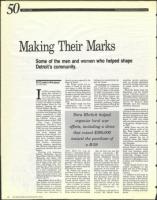
Dora Ehrlich helped
organize local war
efforts, including a drive
that raised $360,000
toward the purchase of
a B-29.
1932. After his trip he
became a dedicated Zionist,
donating and raising literal-
ly millions for Israel. He also
mustered support for the
state among both Jews and
gentiles including Henry
Ford II, who, after a Fisher
appeal, once wrote a check for
$100,000 for Israel.
Mr. Fisher has served as
president of the local Federa-
tion and chairman of the
Allied Jewish Campaign, as
well as head of the national
United Jewish Appeal, and
the Jewish Agency in Israel.
Also a leader in secular
organizations including the
United Way, Mr. Fisher has
been active in the Republican
Party, where he has wielded
But his first love was the
Jewish community. Mr.
Butzel was president of the
Jewish Children's Bureau
and the United Jewish
Charities, and served as
honorary president for life of
the Jewish Community Coun-
cil. He also was a longtime
supporter of the Fresh Air
Society and the Federation.
In the 1930s, Mr. Butzel
dedicated himself to helping
East European Jews fleeing
the Nazis. To that end, he
helped found the Resettle-
ment Service, which to this
day continues to aid new
Jewish immigrants in
Detroit.
In addition to his public ac-
tivities, Mr. Butzel made
countless private gestures,
such as giving donations
toward the college educations
of young Jewish men and
women.
When Mr. Butzel died, the
Federation and the United
Jewish Charities placed a
full-page memorial ad in the
Detroit Free Press. Among the
diverse signatories: represen-
tatives of Yeshiva Beth
Yehudah and the Sholom
Aleichem Institute.
Leon Fram was a native of
Lithuania who first served in
Detroit as assistant rabbi and
director of education at Tem-
ple Beth El. His work there
began in 1925 and ended
when he left to start his own
congregation, Temple Israel,
in 1941.
Rabbi Fram was not the
typical Reform rabbi of his
day. Most temples in the
1930s and 1940s embraced
classical Reform Judaism,
which opposed the use of
religious items like kippot
and talleism, and did not sup-
port Zionism.
Rabbi Fram, however, was a
fervent Zionist who believed
congregants should make
their own decisions about
religious practice. Under his
leadership, Temple Israel
became the first Reform con-
gregation in Michigan to hire
a cantor and introduce b'nai
mitzvah.
Today, Temple Israel is the
largest synagogue in the
state and one of the largest
Reform temples in the
country.
In addition to his work at
Temple Israel, Rabbi Fram
was a founder of the Detroit
Jewish Community Council;
the Detroit Round Table of
the National Conference of
Christians and Jews; and the
League for Human Rights in
Michigan, a leading anti-Nazi
group.
Scanned image of the page. Keyboard directions: use + to zoom in, - to zoom out, arrow keys to pan inside the viewer.
March 27, 1992 - Image 142
- Resource type:
- Text
- Publication:
- The Detroit Jewish News, 1992-03-27
Disclaimer: Computer generated plain text may have errors. Read more about this.