
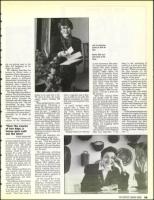

Left, Iris Kaufman
prices an item for
sale.
Below, Ruth Levi
with some of her
finds.
pie are getting used to the
idea. It's becoming an in-
dustry by itself."
Mr. Adelson describes the
process he follows when a
potential client expresses in-
terest — "I do an evaluation,
then there's a half-hour
presentation I go through, ex-
plaining the services of my
company. Also, I explain to
them at the time what they
need to do to get ready, and
what they shouldn't do?'
The client does very little to
prepare. The Everything Goes
crew cleans the house, deter-
mines prices, arranges the
furniture and other items and
advertises the sale. "We sell
everything," he says, "from
the basement to the fur coats,
jewelry, clothes!'
The sale organizers charge
a commission on gross sales —
generally up to about 25
percent.
Mr. Adelson believes the
success of his liquidation
"Over the course
of two days, a
house gets sold
out the door."
Frank Kaszynski
business depends upon a mix
of meticulous research and
common sense. He prides
himself on his collection of
books and computer re-
sources, which he uses to
prepare for a sale. Like Ms.
Kaufman, he is an associate
member of the International
Society of Appraisers, and
makes it his business to keep
up with the going rate on
anything he might find in a
client's home.
Mrs. Adelson conducts her
own research. She spends a
great deal of time in retail
stores, familiarizing herself
with appliances and other
household items.
The Adelsons point out that
careful pricing often deter-
mines how well a sale goes.
"It used to be that at the end
of a sale, you'd end up with
stuff left over," Mr. Adelson
recalls. "You'd have to get a
dealer in to come buy it all.
We don't do that. (In many
cases), there's nothing left
over!"
When preparing for a sale,
particularly following a
death, Mr. Kaszynski recom-
mends that the client not at-
tend the sale. "I suggest to
them that it's going to be very
emotional . . . because your
house fills with strangers,
and they're picking and paw-
ing at everything, finding the
flaws. It's dreadful. Some-
thing that your mother priz-
ed — there's some idiot stan-
ding in the middle of the room
pointing out all the chips and
abrasions in it?'
Chips and abrasions not-
withstanding, people buy.
"It's amazing," Mr. Kaszyn-
ski says. "Over the course of
two days, a house that was
completely full, piece-by-piece
just gets sold away and goes
out the door."
The Adelsons attribute
most of their sales' success to
the energy generated by the
customers who show up to
buy. "You have to be am-
bitious," Mrs. Adelson says.
"You're in (a client's) house
for only two or three days, and
they're trusting that you're
going to sell just about every-
thing and that you're going to
get the highest amount of
money you can get."
On the second day of one
sale, a house was quickly
emptying. Customers made
their way around a jumble of
wicker furniture, classical
records, linens, antiques and
old clothing. Ms. Kaufman
held court at the front door
with a cigarette and a ther-
mos of coffee by her side. She
greeted customers by name,
took cash and bargained with
regulars.
A small wooden table
shaped like a whale sat
among the clutter in the liv-
ing room, where Mary
Bologna searched for bar-
gains. "It's not like going to
a department store where you
just kind of glance through
things. Here, you want to get
ahead of someone, so you can
get that vase or that piece of
clothing. It's the excitement
behind it?'
Shopper Ruth Levi thrives
on the excitement. Her eclec-
tic, contemporary home is fur-
nished with other people's
belongings. She buys their
couches, coffee tables, art
work and accessories, all at
bargain prices. And while
Benno Levi may laugh at his
wife's addiction to the estate
sales whose wares fill their
Oak Park colonial, he
wouldn't deprive her of the joy
she gets from the sales. "I'm
a born shopper," Mrs. Levi ex-
plains. "I've got a great eye
for quality?'
She's been visiting estate
and garage sales for more
thali 20 years, but notes that
it's only recently that others
have expressed interest in her
passion. "I think it's just in
the last 10 years that it's real-
ly become a much more ac-
cepted thing to do — socially
acceptable — because I think
that people now like to talk
about what they got at sales,
and brag about what they got,
rather than hiding the fact.
People are bragging about
their bargains?'
Ms. Adelson sees herself as
the purveyor of the bargains
Mrs. Levi describes. "I am
there to sell something of
quality at a great price that
you can't get anywhere else,"
she says. "Either you can't get
the item because it's not
available anymore, or you can
buy it at an estate sale for a
quarter of the price?'
"If you don't have a lot of
money, it's a great way to fur-
nish your house," says Susie
Friedman, who has been
shopping at estate sales with
her mother for years.
Mr: Kaszynski calls estate
sales " the ultimate recycl-
ing! People are saying, 'You
continue using it. I'm
through with it! It really
makes sense?' He is convinc-
ed that both shopping at and
holding estate sales will
become even more common-
place.
"If the common person ever
got past that stigma of buying
something used, this is the
way we would all shop. It's too
expensive to be buying things
new. Everything you have
ever imagined is available in
one of those houses. Anything
you have ever thought about
owning is there, waiting for
you!" ❑
THE DETROIT JEWISH NEWS
59