

Myths
Continued from preceding page
Ceremonies like
weddings and funerals
may be performed only
by a rabbi.
J
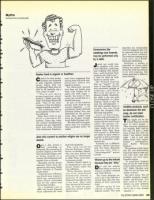
Kosher food is organic or healthier.
ould it be that kosher
are obligated
C c
to pass rigorous physical
exams before they are
slaughtered? Must they be
able to lift barbells, jog a
mile, swim 10 laps?
"There are many
misperceptions about
kashrut," Rabbi Lane Ste-
inger of Temple Emanu-El
said. "One of the most
common is that the dietary
system is based on health."
"The traditional view is
that kashrut is God's law,"
he continued.
Some have tried to put
forth a rationale for
kashrut. Years ago, when
the animal slaughtering
process was not regulated,
pork was often infected
with trichinosis. Similarly,
some have suggested that
mixing meat and milk may
adversely affect the
digestive system.
Yet Halachah (Jewish
law) does not forbid soup
thick with chicken fat or
cakes rife with sugar —
hardly the kind of deli-
cacies one would find in a
health-food store.
As part of the kashrut
process, meat must be rig-
orously inspected — a re-
quirement closely followed
millenia before this was
demanded by the govern-
ment. Also, kosher meat
must be freshly slaugh-
tered, Rabbi Steinger said.
"But this still is no guar-
antee that it's healthier
than non-kosher meat," he
added.
Jews who convert to another religion are no longer
Jewish.
O
nce a Jew, always a
Jew, according to
Halachah. By converting to
another religion, a Jew will
lose certain privileges, such
as being counted in a
minyan. But Halachah still
regards him as Jewish.
Halachah and the Israeli
Supreme Court have dis-
agreed on this issue, Rabbi
Paul Yedwab of Temple
Israel noted.
Under the Law of Return,
any Jewish man, woman or
child may automatically
obtain Israeli citizenship
and all the rights that
citizenship includes.
In a landmark case in
1962, the Israeli Supreme
Court addressed the issue
of Jewish apostates.
The case involved
Oswald Rufeisen, better
known as Brother Daniel,
who was born Jewish but
converted to Christianity
in 1942. Three years later,
he became a monk.
Brother Daniel asked to
be recognized as a Jew and
Israeli citizen under the
Law of Return.
While Brother Daniel
was still considered
halachically Jewish, a
majority of the Israeli
Supreme Court did not vote
in his favor. They ruled
that, because of his conver-
sion, he could not gain
automatic Israeli citizen-
ship as a Jew.
ewish law would have
no problem with your
Uncle Moishey conducting
your wedding. The stipula-
tion — and you knew there
would be one, didn't you? —
is that he must be fully
versed in certain laws.
The Talmud requires
that an "expert" in the
laws of marriage, divorce
and conversion preside at
weddings, said Rabbi
William Gershon of
Shaarey Zedek. Generally,
the rabbi is the one most
knowledgeable in these
matters, which is why he
(and the photographer —
but that's another story) is
usually the one found
under the chuppah with
the bride and groom.
Laws of marriage,
divorce and conversion are
extensive. If, for example, a
woman did not receive a get
under the proper cir-
cumstances, her next mar-
riage might not be con-
sidered valid. Only those
well-versed in Halachah
are likely to know what to
consider so that a marriage
will be acceptable under
Jewish law.
Funerals are a different
matter, Rabbi Gershon
said. For these, Halachah
requires only that a
"knowledgeable" person
preside.
Women go to the mikvah
because they are "dirty."
D
irt and the mikvah
have about as much in
common as Hafez el-Assad
and Ariel Sharon.
The Torah obligates wo-
men to go to the mikvah a
certain time after the com-
pletion of their menstrual
cycle.
Before going to the
mikvah, a woman is con-
sidered niddah. The word
describes her relationship
with her husband. She is to
be separated from him and
have no sexual relations.
The word has nothing to do
with dirt, said Rabbi
Elimelech Silberberg.
Similarly, a woman is
regarded as tamea while
having her period. Rabbis
stress the word has nothing
to do with hygiene, but
rather describes a different
state of being.
a
.
•
Inedible products, such
as aluminum foil and
soap, do not need
kosher certification.
IT
hey might not be the
kind of thing you would
want to serve guests —
"How was your vacation in
Los Angeles, Bob? And by
the way, I'll have a little
more of that foil with my
steak," just doesn't sound
right — but it isn't only
edible items that require
kosher certification,
said Rabbi William
Gershon.
The problem is that items
like foil and dishwashing
liquid are used in close con-
tact with food. And both
products can have ques-
tionable origins.
"It sometimes happens
that oil can be used on the
rollers used to press out the
foil," Rabbi Gershon said.
"And oil can be from non-
kosher sources."
But don't worry. Not all
inedible products require
kosher certification. You
don't need to look for a
heksher on your umbrella
or hair dryer. Unless
you've got a very strange
appetite. ❑
THE DETROIT JEWISH NEWS
23