

Remembering Menachem Begin
The mob forced its way past barbed wire and a cor-
don of 500 police, set fire to autos and threw rocks at
the Knesset. Mr. Begin called Prime Minister Ben-
Gurion "a fascist and a hooligan," and the crowd was
poised to battle its way into the chamber of the Knes-
set, which was in session.
Finally, Prime Minister Ben-Gurion called in the
army, which dispersed the mob.
That afternoon, Mr. Begin, speaking in the Knes-
set, implicitly threatened civil war if funds were ac-
cepted from Germany. The next day, Mr. Ben-Gurion
said that "evil" had been "raised against the sovereign-
ty of the Parliament, and the first steps were taken to
destroy democracy in Israel."
On Jan. 9, the Knesset voted to accept German repa-
rations — and also to deny Mr. Begin his parliamen-
tary seat for 15 months.
Mr. Begin was a voice in Israel's political wilderness
for almost two decades. It was not until June 1, 1967
— just a few days before the Six Day War — that Mr.
Begin achieved his first cabinet post in an Israeli gov-
ernment. Ten years later, he became prime minis-
ter. As his biographer, Eric Silver, wrote, The Israeli
voter had turned out the heirs of Ben-Gurion and elect-
ed the heirs of Jabotinsky. The outcasts became the
establishment."
The smooth transition from Ben-Gurion's Labor gov-
ernment to Mr. Begin's Likud government, was one
of the first true litmus tests of Israeli democracy, sug-
gests Ian Lustick, a professor of government at the
University of Pennsylvania.
"It represented," he said, "an affirmation of Israeli
democracy. Until Begin came in, there had not been
a change of government and no one knew just how
much a conservative government would respect democ-
racy."
Mr. Begin's ascendancy, said Prof. Lustick, also sig-
naled the emergence of two other phenomenons in Is-
rael. One was the Oriental Jews' decision to use Likud
"as a vehicle to express their displeasure with Labor."
The other was Likud's alliance with such aggressive
religious Zionist groups as Gush Emunim.
Mr. Begin ruled Israel for six years and three
months. His governance included what is usually con-
sidered one of Israel's greater political achievements
— its 1979 peace treaty with Egypt, for which he re-
ceived the Nobel Peace Prize. But it also included one
of Israel's worst debacles — its 1982 invasion of
Lebanon, which was marred, first, strategically and,
then, morally by the massacre of hundreds of Pales-
tine refugees at Sabra and Shatilla.
The peace treaty is still the only formal cessation of
hostilities between Israel and Arabs. Prof. Lustick said
the pact "advanced a certain kind of peace." By sin-
gling out Egypt, he said, Israel hopefully removed
Egypt from any future military conflicts. It also, he
said, made Palestinians more reliant on their non-
Egyptian Arab allies, who were weaker than Egypt it-
self, and also "sowed the seeds of the intifada and
the war in Lebanon."
To Mr. Begin, the Sinai, which Israel had conquered
in 1967 and agreed to return to Egypt under the peace
treaty, was expendable. Indispensable to Israel was
38
FRIDAY, MARCH 13, 1992
the West Bank which, in his lexicon, was Judea and
Samaria. It was part of Israel's past since God had be-
queathed it to Abraham. And, it was essential to Is-
rael's future, he asserted, since it buttressed the
security of the Jewish state.
"If anyone wants to take Judea and Samaria from
us," he said in 1982, "we will say Judea and Samaria
belong to the Jewish people to the end of time."
But it was the incursion into Lebanon that devas-
tated the prime minister. He was appalled at the lee-
way that defense minister, Ariel Sharon, took with the
original, limited mandate to enter Lebanon; shat-
tered by the moral fallout from Sabra and Shatilla;
and stunned at the overall loss of life.
On Sept. 15, 1983 — the day Mr. Begin submit-
ted his resignation — Israel buried its 513th soldier
killed in the war.
The reclusiveness that enveloped Mr. Begin about
mid-way through the war was hastened by the death
of his wife, which came almost two months after Sabra
and Shatilla. It was not eased by hostile comments
from abroad, such as these from New York Times
columnist, James Reston.
Senior American officials, he wrote, "feel Mr. Begin
is a certified disaster for Israel and the rest of the
world."
Menachem Begin spent the last few months of his
administration holed up in his home. Tired and alone,
he rebuffed supporters who petitioned him to remain
in politics with five succinct syllables: "I cannot go on."
When he left office, Israel was reeling from an an-
nual inflation rate of 130 percent, industrial produc-
tion was stagnant, imports were seriously outpacing
exports, and foreign debt had soared by $550 million
to $21.5 billion just in the first half of 1983. Even worse,
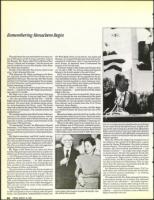
Leaving Shaare Zedek Hospital in Jerusalem with daughter, Hassi,
after an illness three years ago.
the war in Lebanon had eroded Israel's moral footing
in the world. For all his talk of harad, of pride in be-
ing Jewish and in living in a Jewish state, Menachem
Begin seemed to have come to a tragic and reclusive
dead-end in which he had difficulty reconciling the
ideals by which he lived his life with the reality he had
helped engender.
Since the 1940's, Mr. Begin had wrapped most of
his politics in the mantle of the Holocaust, a tactic
scorned by George Washington University professor
Howard Sachar. The historian said that the prime
minister, "By word and deed, had politicized — and
thereby trivialized — the single most tragic chapter
in Jewish history. He also cdemagogized' Israeli poli-
tics far more than the ultra-rightist parties have done."
A posthumous "Begin strain" of politics continues
in Israel today, said Prof. Lustick, in the Likud Par-
ty's idea of autonomy for Palestinians. This, he said,
stems from the autonomy of minorities that Mr. Be-
gin had observed in eastern Europe.
But Menachem Begin's greatest legacy, Prof Lu-
stick noted, may well be the one he says is most lack-
ing in Israel's present leadership — an abiding,
pervasive sense of morality.
Throughout his life, Mr. Begin attempted to balance
a demanding ideology and a politics that addressed
the world in very real terms — the reality of power.
That he ended up a recluse after toiling in this cru-
cible for several decades may not have been surpris-
ing: Such balances require extraordinary psychic
stamina — and even as tireless a man as Menachem
Begin eventually wore out.