

I CLOSE-UP I
oting is a serious
matter to Nat Fish-
man, a recently
retired West Bloom-
field businessman.
"It is an inalienable
right," he said. "For a
citizen, voting is a perk. If
everybody votes, then it
means something."
He is not a Republican or
a Democrat, and he has
supported candidates from
both parties. He is espe-
cially proud because he has
missed just one election
during his life.
Yet most important, Mr.
Fishman says, is his Jew-
ishness, and he will con-
sider that heritage when
he casts his ballot Tuesday
in the Michigan Democrat-
ic presidential primary.
Like so many Jewish
voters, Mr. Fishman says
he votes "Jewish." In a
presidential race, that
means Israel is his first
concern.
"My first issue is attitude
toward Israel because I'm
prejudiced," he said. "In a
presidential race, a can-
didate must be more pro-
Israel than anti. I believe if
we don't help ourselves, no
one will help us."
Mr. Fishman is closely
watching Campaign '92, in
which the issues are as plen-
tiful as the slate of
candidates.
President George Bush is
in a bit of political trouble.
Americans upset over the
abysmal state of the econ-
omy are largely holding
Mr. Bush responsible for
their fate. Women's
groups, angry over the ex-
pected overturn of the
landmark 1972 Supreme
Court decision giving wo-
men the right to abortion,
blame Mr. Bush for his re-
cent choices of conservatives
David Souter and Clarence
Thomas to the U.S. Supreme
Court.
Mr. Bush has come under
close scrutiny in the Jewish
community over the
postponement of $10
billion in loan guarantees.
He has repeatedly linked
V
26
FRIDAY, MARCH 13, 1992
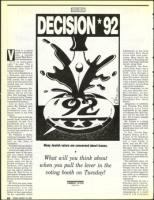
Many Jewish voters are concerned about issues.
What will you think about
when you pull the lever in the
voting booth on Tuesday?
KIMBERLY LIFTON
Staff Writer
settlements in the Arab
controlled West Bank
areas with loan guar-
antees. Many believe the
president is dismissing the
power of the large American
Jewish voting block.
Meanwhile, the Dem-
ocratic Party hasn't won a
presidential race since
1976, when Georgia's
Jimmy Carter defeated
then-President Gerald
Ford. Now the party thinks
it has a chance, despite the
controversy surrounding
some of the candidates.
Still remaining in the
race are Arkansas Gov.
Bill Clinton, former
Massachussetts Sen. Paul
Tsongas and former
California Gov. Jerry
Brown.
Allegations of infidelity
and Vietnam War draft
dodging have been
highlighted by the media
in Arkansas Gov. Bill Clin-
ton's bid for the Oval Of-
fice. Yet it hasn't stopped
his momentum.
Mr. Clinton is a strong
liberal and an outspoken
supporter of Israel, which
should place him well with
Jewish voters.
In fact, Jewish Rep.
Stephen Solarz, D-N.Y.,
author of the Religious
Freedom Restoration Act
and a loyal friend to
Israel, may join Mr. Clin-
ton on a campaign stop in
Michigan this week. He
and Connecticut's Jewish
senator, Joe Lieberman,
are publicly endorsing Mr.
Clinton as a good choice for
Jewish voters.
The politically clean, yet
less charismatic former
Massachusetts Sen. Paul
Tsongas also has been do-
ing well in the race. Some
political pundits suggest he
may make up in substance
what he lacks in political
magnetism.
In the Senate, he was a
Dukakis-style liberal,
voting similarly to his col-
league, Massachusetts Sen.
Ted Kennedy. Now he is
campaigning as a social
liberal and economic