

DETROIT
AMY J. MEHLER
Staff Writer
I
n the former Soviet
Union, Tanya Karpinsky,
16, studied the same sub-
jects with the same group of
students every day. School
was as dreary and as
colorless as the plain brown
dress and heavy black apron
she wore year-round.
Seventeen-year-old
Vladimir Gendleman was
sent to Soviet military class.
His school wardrobe con-
sisted of blue pants and
jackets. Often, the boys were
punished and sent home if
they didn't pass inspection.
Today, Vladimir and
Tanya, juniors at Berkley
High School, look like your
average jean-clad, fun-
seeking teen-agers. But
while their classmates spend
hours mastering the social
whirl of American high
school, Tanya and Vladimir
spend hours mastering Eng-
lish, the one thing they say
distances them most from
their American counter-
parts.
Fifty new American
students now study at
Berkley High School. And
every one of them takes part
in the school's bilingual
teaching program.
However, these former
Soviet students admit they
tend to stick close together.
Assimilation is difficult even
at Berkley, whose student
population is diverse.
"Learning English is
probably the hardest thing
about starting over," ad-
mitted Tanya, a former resi-
dent of the Ukraine. "We are
different from the American
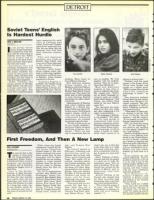
Photos by Glenn Triest
Soviet Teens' English
Is Hardest Hurdle
Tzvi Lamden
Sasha Tsalenko
Ivan Federov
students. Many times, we
have different interests."
New American students
Grisha Lamden, 14, of
Moldavia, and Ivan Federov,
14, of St. Petersburg, started
Berkley High School several
months ago. They spend the
better part of each morning
in class learning English
and going over other classes'
homework.
Approximately 30 Berkley
high school students take
English as a Second Lan-
guage classes as a regular 55-
minute course. The bilingual
support classes, which re-
view and help students
understand homework
assignments, are available
as a second, separate class.
"We like to keep an eye on
all our foreign students,"
said Laura Gugola, bilingual
teaching program coor-
dinator. "That's the best
way to mainstream them as
soon as possible. We work
together with the students'
teachers. They let us know
where they fall behind."
Most new American
students do fine when it
comes to subjects like math,
Mrs. Gugola said. "There's
not as much language in-
volved in math, so I under-
stand what's going on," said
Grisha, who prefers being
called by his new Hebrew
name, Tzvi.
Tzvi was given his name,
Hebrew for deer, four weeks
ago, after undergoing a brit
milah, or circumcision.
"Yes, language is definite-
ly the hardest," Tzvi decid-
ed. "It's hard enough to
understand what every
American expression means.
Sometimes I wish I had come
to the United States earlier.
The language problem
makes it harder to under-
stand what's going on in
physics or science class."
Vladimir said his math
classes in the former Soviet
Union were harder and
taught on a higher level.
"Math is easier here, but the
American computer
technology is better," he
said.
New American students
haven't been the only ones to
benefit from Berkley's bil-
ingual program. The pro-
gram originated in 1978 to
teach Chaldean students,
who come from Iraq.
"Then about 10 years ago,
we started to get the first
wave of Soviet Jewish
students," said Mrs. Gugola.
"So we geared up and hired
Russian- speaking staff."
Still, it's never easy being
new. "In the beginning, I
was afraid to say anything
in case people laughed at
me," said Vladimir:
School in the former Soviet
Union is very different from
school in the United States,
he said. In Russia, students
go to school in morning and
afternoon shifts. Elementary
school children start school
at 8 a.m. and finish at 3 p.m.
Middle and high school
students go from noon to 6
p.m.
Soviet students are also
graded differently. They're
graded on scales of 1 to 5 and
1 to 10, with 5 and 10 the
highest grades. Children are
not allowed to choose their
courses, and they remain
with the same classmates
until they graduate.
Kate Garbozova, 15,
formerly of Moscow, said
students in Russia teased
and picked on her because
she was Jewish.
"They would say I talked
funny, like a Jew, and would
spit in my face," she said. "I
remember once in fourth
grade, my girlfriend told me
her parents wouldn't let her
First Freedom, And Then A New Lamp
PHIL JACOBS
Managing Editor
T
he miracle that is the
exodus of Jews from
the Commonwealth of
Independent States, former-
ly the Soviet Union, is one of
religious and economic
freedoms and of families
making the biggest move of
their lives.
Lost in the drama,
however, is often the prac-
tical side of life. It's wonder-
ful that the new arrivals
have gotten here and are
beginning new lives, but
along with freedom is a need
for a lamp that works, toys
for the children, towels for
the bathroom and even a
nice piece of artwork for the
wall.
14
FRIDAY, MARCH 13, 1992
That's where the Jewish
Community Council-led So-
cial Action Committee
Council comes in. The com-
mittee, combined with social
action groups from 18 area
synagogues and the Reset-
tlement Service are working
together to collect donated
practical items for the new
arrivals under its Helping
Hands Drive For New Ar-
rivals Program.
The list of congregations
includes: Adat Shalom, the
Birmingham Temple, Con-
gregation Beit Kodesh, Beth
Abraham Hillel Moses, Beth
Achim, Beth Isaac, Beth
Shalom, B'nai David, B'nai
Moshe, Shaarey Zedek, Shir
Tikvah, T'Chiyah, Temple
Beth El, Temple Emanu-El,
Temple Israel, Temple Kol
Ami and Temple Shir
Shalom.
The Council started in
February, collecting and
distributing small ap-
pliances such as irons, hair
dryers, vacuum cleaners and
lamps. This month will be
artwork, including posters
and framed paintings and
small throw rugs. For April,
the group will collect clean-
ing necessities such as pails,
brooms, mops and sponges.
For May, it will be toys and
children's and infant car
seats, and for June,
bedspreads and gently used
towels will be collected.
"These items help our new
arrivals feel they have a
home rather than just a
place to be," said Domestic
Concerns Task Force chair-
man Robert Brown. "And
what's also nice is that this
is the first time in a while
that social action has work-
ed in a community-wide pro-
ject. It comes at a most need-
ed time."
Marcy Feldman of Reset-
tlement said that the project
is a good way to make the
community aware "that we
need everything. We're get-
ting 80 new arrivals for the
month of March, and we
desperately need these
things now."
Beverly Phillips of the
Council, also stressed that
the effort was being made
community-wide to provide
day-to-day household items.
"This is the first project of
its type," she said. "One
congregation is helping an-
other and we're working
together." ❑