

HIDDEN
DETROIT
city, it features a number
of stained glass windows —
the largest of which is a
six-pointed star.
Visitors frequently in-
quire about the star, accor-
ding to the Rev. Leo Reilly,
associate pastor at St.
Anne's, who gives tours of
the facility. He believes the
star was incorporated on
the window because of its
association with religious
tradition.
The six-pointed star,
Magen David ("Shield of
David" in Hebrew), was
considered a magical sym-
bol in the Bronze Age. Dur-
ing the time of the Second
Temple, use of the six-
pointed star (hexagram)
was widespread; a Caper-
naum synagogue even
features the hexagram, a
pentagram and a swastika,
all considered signs of good
fortune.
In later centuries, Arab,
Christian and Jewish
groups used the six-pointed
star. The Arabs called it
26 FRIDAY, FEBRUARY 21, 1992
the "seal of Solomon," and
it was often found on Jew-
ish homes within mezuzot.
Sometime around 1200,
the hexagram became
known as the Magen
David, though the Jewish
community at large did not
identify it as a Jewish
symbol.
Then in 1354, King
Charles IV allowed the
Jews of Prague to have
their own flag. Called King
David's Flag, it featured
the six-pointed star.
Usage of the hexagram
as a Jewish symbol began
to spread to other cities
after the creation of King
David's Flag. But it was
only in the late 1800s that
the star became identified
predominantly as a Jewish
symbol.
Today, Israel uses the
menorah as its national
symbol, though the Magen
David appears on the
state's flag.
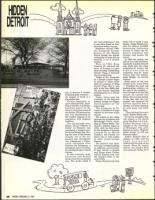
The hexagram at St.
Anne's is located on a large
window at the front of the
church.
The parish is the oldest
between the Allegheny and
Mississippi rivers, accor-
ding to Father Reilly. The
church's register began in
1704, with its first entry
for the daughter of Antoine
Laumet de la Mothe
Cadillac, the French ex-
plorer who in 1701 landed
in what would become
Detroit.
The church's first struc-
ture was a wooden building
on Jefferson and Griswold.
It later moved to Lamed
and Bates when Father
Gabriel Richard took over
the church's helm in the
early 1800s.
Father Richard had little
choice but to build a new
facility. Judge Woodward's
plan for Detroit included
extending Jefferson
Avenue to where the St.
Anne's cemetery was
located, just beside the
church.
In 1886 the church was
split in two, with half form-
ing the St. Joachim Church
near Belle Isle, the other
remaining St. Anne's, but
with_a new site at
Lafayette and St. Anne
streets near the Ambas-
sador Bridge, its current
location.
Some parts of the new
church on St. Anne Street
— including the altar and
stained-glass windows on
the side of the building —
were brought over from the
church on Larned and
Bates. This was due mainly
to the fact that the con-
gregant who designed the
current facility was a
devotee of Father Richard,
as were many who knew
him.
"They believed he was a
saint," Father Reilly said.
An active, energetic man
who prayed in his church
every day from 1 to 2 a.m.,
Father Richard was a
founder of the University
of Michigan who gave
Detroit its motto, "Hope for
better things; it will rise
from the ashes."
Father Richard died of
cholera in 1832, and his
body was buried
underneath the altar at his
church. When St. Anne's
moved, the priest's body
was exhumed. Today, he is