

ing the world functioned
according to natural law.
He saw the Torah as a
purely human, historical
writing.
Excommunicated by the
Jewish community in 1656,
Spinoza left Amsterdam
and subsequently lived in
Rijnsburg, Voorburg and
The Hague. He spent most
of his life teaching and
writing. His books included
Treatise on the Rainbow,
Tractatus Theologico-
Politicus, Short Treatise on
God, Man and His Well Be-
ing and Ethics. The latter,
Spinoza's major work, was
not published in his
lifetime after religious
leaders complained that
the philosopher denied
God's existence.
In fact, Spinoza did not
deny the existence of God,
but rather saw Him as the
world itself, as inseparable
from nature. It was only
through an intellectual
love of God and recognition
of His rational order that
one could achieve true
happiness, Spinoza said.
Spinoza died in 1677 of
tuberculosis.
AN UNUSUAL LEGACY
Nathan and Esther Kor-
man had nothing when
they came to the United
States — no money, no sur-
viving family members.
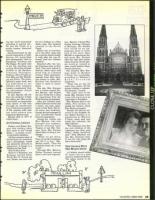
All that remains today of
the Kormans are memories
and a photograph, tinted
and distinctly old-world in
appearance. It hangs in a
building in Oak Park.
Here is their story.
Natives of Romania, the
Kormans married before
World War II. During the
war, Esther was sent with
her two children to a Nazi
death camp. Her husband
escaped to the Soviet
Union.
Esther was so overwork-
ed in the Nazi camp that
she would be almost unable
to walk after she was lib-
erated; both her children
perished.
Reunited after the war,
the Kormans came to New
York. They later settled in
Detroit, where they sold
fresh fish on Linwood
Avenue. Their apartment,
upstairs from their store,
was always in order. Mrs.
Korman was fastidious
when it came to clean-
liness.
One day, Mrs. Korman
met a woman named Ber-
tha Merzon, who helped
her new friend file a claim
for reparations from the
West German government.
After her husband died,
Esther Korman moved into
a small, one-room apart-
ment in Oak Park. She liv-
ed alone and modestly,
though she had managed to
save considerable funds
from the reparations.
Among her visitors was
Mrs. Merzon, who also
brought her nephew,
Detroit attorney Gary
Torgow, to see Mrs. Kor-
man. Once, Mrs. Korman
asked them to bring a can-
taloupe.
"When we got there,
Gary cut up the cantaloupe
and fed it to her," Mrs.
Merzon recalls. "Then she
kissed his hand. Ah, it was
so sad."
Through Mrs. Merzon,
Esther Korman learned
about a new local organiza-
tion, Machon L'Torah-The
Jewish Learning Network
of Michigan. She decided
this would be an ap-
propriate place to leave
half of the more than
$80,000 in reparations she
had saved. Mrs. Korman
liked the idea that money
taken from the Jewish peo-
ple would go instead to
what would sustain them:
Jewish education.
The donation Mrs. Kor-
man made to Machon
L'Torah was invaluable,
according to Machon's
Rabbi Avraham
Jacobovitz.
"There was no way we
could have gotten off the
ground without a substan-
tial donation," he said.
The other half of the
funds, Mrs. Korman wrote
in her will, was to go to an
orphanage in Jerusalem.
Mrs. Korman died in the
1980s. Five persons at-
tended her funeral, which
Mrs. Merzon arranged.
Though she had no sur-
vivors to say Kaddish for
her, Esther Korman is re-
membered at Machon
L'Torah, which each year
marks her yahrtzeit, the
19th of Kislev.
"The Gemarah says that
the real children of the
righteous are their good
deads," Rabbi Jacobovitz
said. "This (Machon) was
like Mrs. Korman's baby.
It was the only thing she
left in this world."
A Catholic church called
St. Anne's sits on a quiet
street in southwest Detroit.
The oldest church in the