

Voices
Moscow
from
brew, about Israel.
"The situation in what used to be the Soviet Union
is very complex for us," Mr. Ben-Dor explains. "There
is a process of disintegration of this huge country
that is complicated by economic and political reforms,
which sometimes increases destabilization."
When pressed about fluctuating rates of emigra-
tion to Israel and the Jewish state's newly restored
diplomatic ties with Russia, his response is applica-
ble to many questions a visit here raises.
"You are asking the right questions," he says. 'There
are just no answers."
country is a struggle.
"You have to be born here to
understand what being a So-
viet Jew means," says the Or-
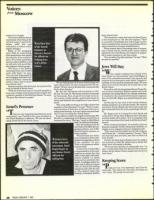
thodox rabbi who was Yosef Ben-Dor,
ordained at a yeshiva in Bu- of the Israeli
dapest, Hungary.
Rabbi of the synagogue Embassy in
since 1980, he understands
Moscow, focuses
that assimilation has gutted
his efforts on
the identity of his country's
Jews. He evades questions, helping Jews
however, about whether or not
he will work with non-Ortho- learn about
Israel.
dox religious Jewish groups.
"We know of the Reform
community here, but we don't
work with them," he says.
"You can't just bring people to
the synagogue and make a be-
liever out of them. I stress the
positive sides, that we have
our cultural roots."
Despite questions about his past, he is proud of his
work on behalf of Soviet Jewry.
"With all of the hard times it was still possible to
keep some religious life going and give people who
wanted to partake of that life that chance," he says.
"We gave that chance to people."
Jews Will Stay
c
"We are helping them to do some Jewish things and
learn about Israel," he says, leaning forward for em-
phasis. "If they want to develop their communal life,
that is their decision."
Mr. Ben-Dor left Russia with his family in 1975.
He was 14 years old. His family had been refuseniks
for three years. Now, at age 31 he is back in his na-
tive country to help combat a general anti-Israel at-
titude and facilitate the emigration of more Jews to
Israel.
"The most difficult thing is the fight against the
prejudice (of the Russians)," he says. "There is a gen-
eral stereotype of Jews here as the ones who are ex-
celling in the economy. It is very hard to convince them
here is a very important point that you must that we are not ruling the United States."
In an effort to combat the negative stereotypes, Mr.
understand," says Yosef Ben-Dor, press secretary at
Ben-Dor
is negotiating with Russian authorities to
the Israeli Embassy in Moscow. "We are not devel-
broadcast the series, "Heritage," based on Abba Eban's
oping Jewish life in the Soviet Union.
book, on national television.
How the breakup of the So-
viet Union will affect the em-
igration picture, one of Mr.
Ben-Dor's prime concerns, re-
mains unclear..
"We don't have any indica-
tions whatsoever about inde-
former hero
pendent immigration policies
of the republics," he says.
of the refusenik
"This is an enormous infras-
movement, Yosef
tructure shift."
A visit to his crowded office
Begun hopes to
is representative of the chal-
sue former Soviet
lenge his co-workers face. One
table is piled high with infor-
officials for
mation packets on Israel
jailing him.
being sent to potential emi-
grants. A colleague sits at an-
other desk stuffing envelopes
with one hand and making
telephone calls with the oth-
er. The shelves bulge with
booklets, in Russian and He-
Israel's Presence
Ir
A
26
FRIDAY, FEBRUARY 7, 1992
hen people complain here I think of the
times when we were arrested," says Yosef Begun, a
hero of the refusenik movement who served a jail
sentence for his attempts to make aliyah. 'Despite ev-
erything we have good developments today. We have
aliyah and we have freedom for Jewish life in the
Soviet Union."
Now active with the Israel-based Soviet Zionist Fo-
rum in Israel, the former Hebrew teacher and math-
ematician was visiting Moscow for a Zionist conference.
It resulted in the country's first Zionist organiza-
tion, of which Mr. Begun was named honorary pres-
ident.
On this day he has come to the Israeli embassy
seeking assistance on a private matter. He wants to
sue former Soviet officials who threw him in jail and
gain transcripts from the court proceedings of his tri-
al.
Mr. Begun says it is imperative that Israel and
world Jewry let the Jews of Russia know that they
would be better off in Israel. "It is so important that
we make connections from Israel to all the Jews here,"
he says.
From a bulging backpack, he excitedly pulls out
Russian-language Jewish educational material, in-
cluding a new magazine that he is helping to edit.
"They need what they didn't have for the whole pe-
riod of their life — Jewish education," he says. "They
are clear that they are Jews, less clear on what it is
to be Jewish."
On this, his third trip to Russia since his emigra-
tion to Israel in 1988, Mr. Begun has no doubt that
many Jews will remain in Russia.
"Of course the situation is unbearable now," he
says. "I really don't know how they live here, but as a
former Soviet citizen I know people here can live in
hard times."
Keeping Score
cc
P
eople are very, very depressed," says Yuri Se-
menovsky. "Our stores are very dirty, the shops are
very empty. The people are nervous."