

BACKGROUND
INA FRIEDMAN
Special to The Jewish News
onsidering all Israel
has been through in
the past year, it is
only natural that its citizens
are hardly in a twitter over a
matter as mundane as early
elections.
"They'll do whatever they
want anyway," a roving
reporter for Israel Radio
heard one stall owner grouse
in Jerusalem's Mahaneh
Yehudah market, tradi-
tionally a Likud stronghold.
"Believe me, I'm not inter-
ested," another chimed in,
and a third volunteered that
he intended to put a white
slip into the ballot box, the
classic way of saying
"They're all rascals."
Ready or not, however,
Israel is plunging headlong
into an election campaign. It
began last Sunday when
Yitzhak Shamir's 19-month-
old government was
deserted by the Tehiya and
Moledet parties, two coali-
tion partners from the
radical right. They dropped
out less because Mr. Shamir
had betrayed their common
cause — holding on to every
inch of Greater Israel —
than for the gains they stand
to make by having early
elections.
They also seem to have
captured a sense of the
public mood that others
missed. In a poll taken by
the afternoon daily Yediot
Aharonot before the two par-
ties announced their inten-
tion to bolt, the majority of
the Israeli public (57 per-
cent) expressed the desire to
have the elections moved up
from the scheduled date in
November.
That most Israelis want
elections quickly seems in-
disputable. Harder to under-
stand is the reason why,
since the same poll shows
that they have not had any
significant change of heart
about their electoral
preferences.
Labor stands to hold on to
its 38 Knesset seats. The
Likud may acquire one seat
(breaking the tie between
them), while the three
smaller right-wing parties
will gain as much as 3 seats
among them. All the other
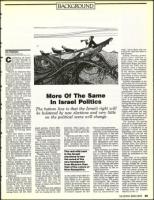
More Of The Same
In Israel Politics
The bottom line is that the Israeli right will
be bolstered by new elections and very little
on the political scene will change.
small parties, which effec-
tively function as three blocs
— religious, leftist, and Arab
— will either hold their own
or pick up one seat (per bloc)
at most.
The caveat attached to the
poll is that conspicuously
absent from the sample were
new Russian immigrants,
whose votes may decide the
character of no fewer than 7
seats in the next Knesset.
Though these newcomers
are viewed as the wild card
in the upcoming election,
few believe they will provide
an electoral upset, changing
the balance in Labor's favor.
On the contrary, the conven-
tional wisdom has it that on
defense and foreign affairs,
which is the basis upon
which 90 percent of the
Israeli electorate is thought
to decide its vote, they are
hard-liners who will go
either with the party in
power or those even further
to the right.
So the bottom line appears
to be that the Israeli right
will be bolstered by new
elections. Then again, the
right was in power anyway,
so why the rush to get to the
polls?
Observers provide a varie-
ty of explanations, but
perhaps the most persuasive
is that all the parties on the
right, including the Likud,
are interested in cashing in
The real wild card
in the Israeli
elections is less
the mood of the
new Immigrants
from Moscow than
that of the voters of
New Hampshire.
on the public mood while it's
still supportive. Put bluntly,
there seems to be a general
sense that the longer the
present government stays in
power, the more things can
go wrong. Topping the list of
potential pitfalls is the issue
of Israel's request for $10
billion in loan guarantees.
It may well be that the real
wild card in the forthcoming
Israel elections is less the
mood of the immigrants
from Minsk and Moscow
than that of the voters in
New Hampshire and what
they signal about the need to
revamp America's fiscal
priorities.
That, however, is a factor
over which Yitzhak Shamir
has no control. His job, in
order to secure the coveted
guarantees, has been to keep
the Israeli government on its
best behavior, showing that
it did not sabotage the peace
talks and exercising max-
imum restraint in the oc-
cupied territories.
Meanwhile, as marathon
consultations take place
within the various parties,
what stands to happen now
remains unclear. For public
consumption, Mr. Shamir
has tried to play down the
gravity of finding himself at
the head of a minority
government. "After all," he
told an interviewer last
week, "we're short only one
vote of 60" (half the seats in
the Knesset).
Indeed, minority govern-
ments have endured in
Israel before, even during
tough times. (For example,
Menachem Begin led Israel
through the 1982 war in
Lebanon with a minority
government.) Nevertheless,
of the various possibilities
discussed these days, the
least likely is that a minori-
ty government will muddle
through till November.
Equally improbable is the
notion that one of the parties
that left the government will
change its mind and return.
That leaves only two
possibilities, both of which
lie in Labor's hands. One is
to topple the government by
a vote of no confidence; the
other is to pass a motion
dispersing the Knesset and
moving elections up to a date
agreed upon with the Likud.
Either way, the political
system is slated to be preoc-
cupied with itself not only
until the elections but until
the next government is
formed (which could be mon-
ths after the actual ballot).
For starters, the parties
have yet to choose their can-
didates for the Knesset.
Labor is scheduled to go
through a series of votes,
beginning next month with
a last-chance race for the
party leadership between
Shimon Peres and Yitzhak
Rabin and then moving on to
"primaries" for the party's
Knesset slate. The Likud is
even further behind in the
process; it has yet to hold
elections for the body (its
Central Committee) that
elects its candidates for the
Knesset.
And what of the regular
business of statecraft while
all this is going on? Oddly
enough, though Mr. Shamir
insists there's no reason why
elections should interfere
with the peace process in
any way, it is Labor's Peres
who has called for a halt to
the negotiations until a new
government can be formed.
Stayed turned for further
surprises. The election cam-
paign is already in progress,
and aficionados of Israeli
politics know that stranger
things may yet happen
before it's over.
❑
THE DETROIT JEWISH NEWS
29